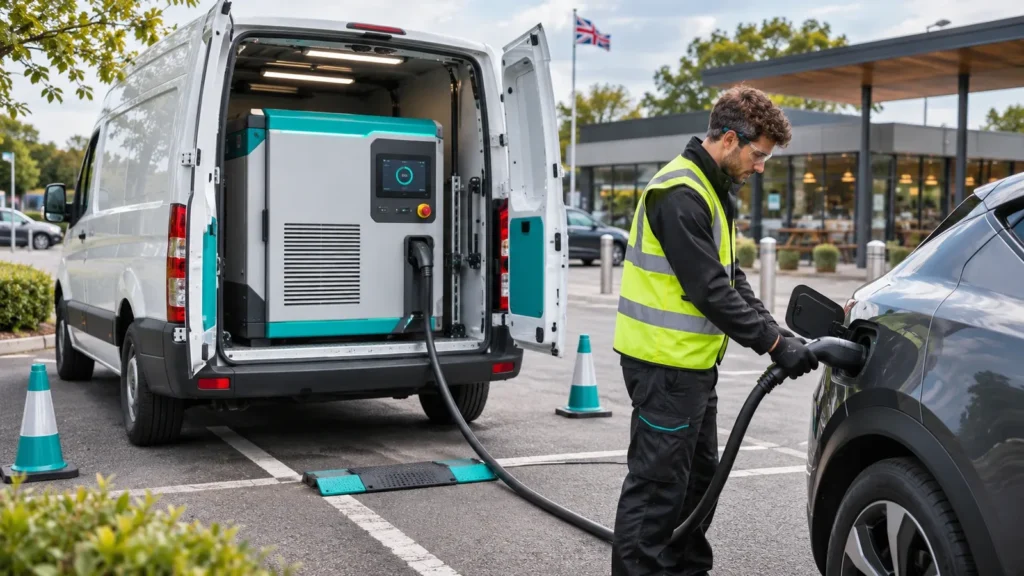
In short: a mobile EV charging business brings charging to vehicles instead of the other way round, using battery units on vans, trailers or skids. The strongest markets are business customers: fleets waiting for depot connections, events and film sets, and recovery services. Success depends on keeping units busy, recharging them cheaply, moving them legally and safely, and choosing hardware that stands up to daily use. Check how charging rules apply to your service before you launch.
Mobile charging fills gaps that fixed chargers cannot: places without a suitable supply, sites waiting for a grid connection, and vehicles that have run flat. For anyone starting a mobile EV charging business, this guide covers the models, the costs that matter and the practical points to settle before you invest.
Who buys mobile charging?
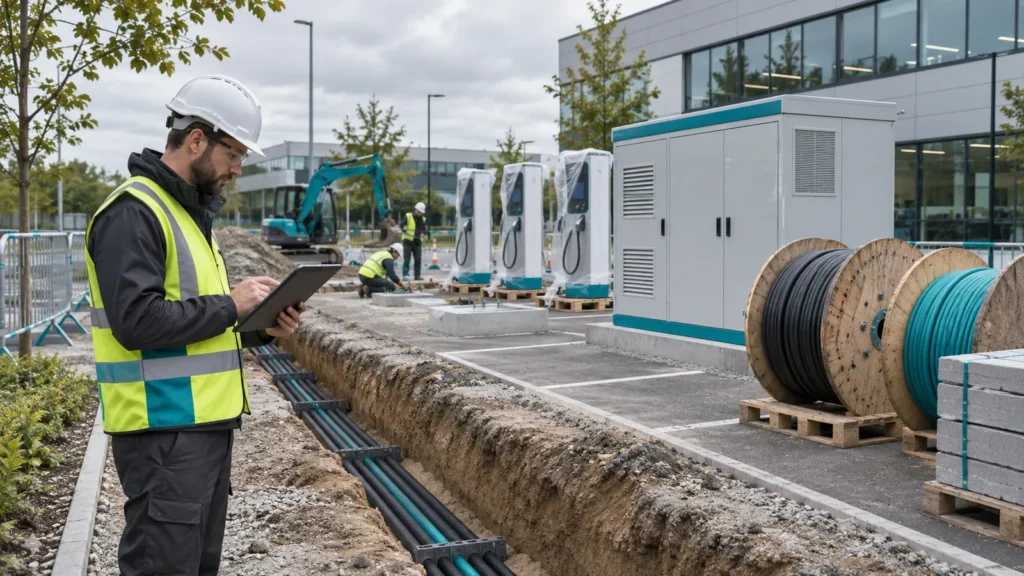
- Fleets waiting for power: depots whose grid connection is delayed; see options while you wait for a grid connection.
- Events and film sets: charging for vehicles and power for equipment; see battery power for events.
- Recovery and roadside services: enough charge to get a vehicle to a charger.
- Construction and temporary sites: charging site vans and plant; see temporary power supply.
- Car parks and dealerships: charging cars where fixed chargers are not yet installed.
Which business model?
| Model | How you earn | Watch out for |
|---|---|---|
| Hire | Units rented by the day, week or month | Utilisation between hires, transport costs |
| Charging as a service | Price per kWh or per session delivered on site | Staff time, recharging logistics |
| Contract | Fixed monthly fee for a fleet or site | Committing capacity, service levels |
| Emergency call-out | Fee per call-out | Unpredictable demand, response times |
What equipment do you need?
Mobile chargers range widely in size, and differ from socket-powered portable EV chargers. One manufacturer’s trailer range, listed by Tursan, runs from 30 kW with 30 kWh of storage up to 200 kW with 200 kWh. Choose on usable energy per shift, continuous output, recharge time, connectors, software and durability. Our guide to what to check before you hire or buy covers the six checks that matter, and mobile energy storage explained covers the technology.
How will units move?
Batteries are heavy, so plan transport early. GOV.UK guidance says drivers who got their licence from 1 January 1997 can tow a trailer that weighs up to 3,500 kg MAM, and the fully loaded car and trailer must not exceed the vehicle’s gross train weight. Check each unit’s laden weight against your vehicles and drivers’ licences, or use van-mounted units instead.
Which rules apply?
The Public Charge Point Regulations 2023 apply to charge points intended for use primarily by members of the general public, with duties on payment, pricing, helplines and data. The regulations do not expressly exclude mobile equipment, so if you plan to charge members of the public, take advice on how they apply to your service. For business customers, write charging standards and responsibilities into your contracts. Electrical safety, insurance and safe handling of lithium-ion batteries apply in every case.
What makes it profitable?
- Utilisation: units earning most days, not sitting in a yard.
- Cheap recharging: recharge from off-peak supply or customers’ own sites where possible.
- Efficient logistics: routes and depots that keep transport costs down.
- Reliable kit: downtime costs both revenue and reputation; see EV charger maintenance.
The same economics apply as for fixed hubs, where utilisation drives payback; see are EV charging hubs profitable?
Frequently asked questions
Is mobile EV charging a good business?
It can be, with steady business customers and high utilisation. Occasional consumer call-outs alone rarely keep expensive units busy.
Do I need a special licence to tow a mobile charger?
It depends on the trailer’s weight and when the driver got their licence. Check GOV.UK towing guidance against each unit’s laden weight.
Should I buy or lease units?
Leasing reduces upfront cost while demand is uncertain; buying can pay off once units are consistently busy.
Our market entry strategy service tests mobile charging business plans and equipment choices. Tell us about your plans.