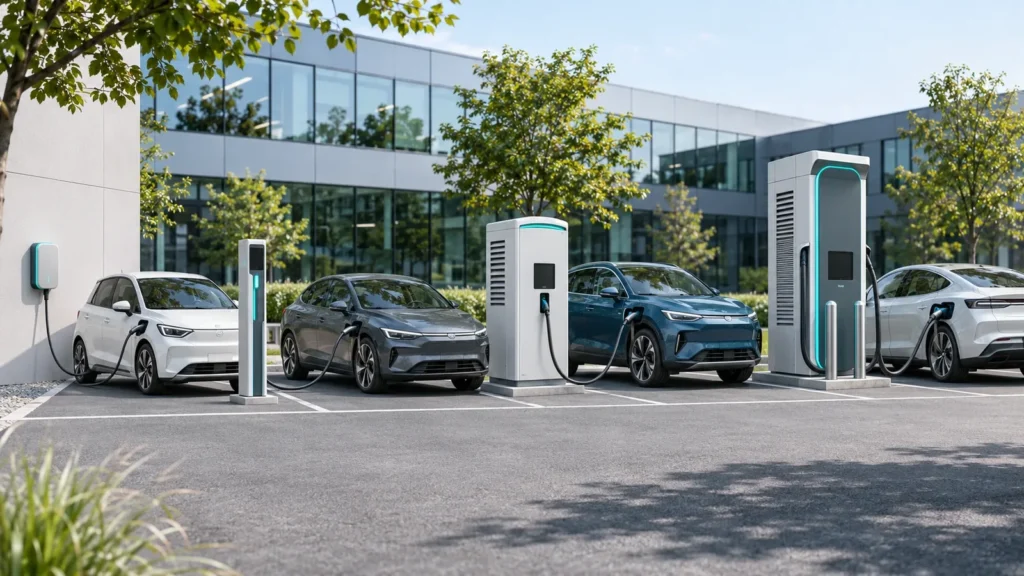
In short: choose charger power from how long vehicles stay and how much energy they need, not from the biggest number available. A 7 kW charger suits cars parked all day or overnight. 22 kW helps where the site has three-phase power and vehicles can accept it. 50 kW DC suits stays of around an hour, and 150 kW and above suits short stops and busy routes. Always check what the vehicle can accept, because it sets the real charging speed.
Charger power is quoted in kilowatts (kW): the rate at which energy can flow. Energy is measured in kilowatt-hours (kWh). Dividing the energy a vehicle needs by the charger’s power gives a rough charging time. This guide shows how the common power levels compare and where each fits. For what the UK terms rapid and ultra-rapid mean, see rapid vs ultra-rapid EV charging.
What do the common power levels mean?
| Power | Type | Typical supply | Best for |
|---|---|---|---|
| 7 kW (about 7.4 kW) | AC | Single-phase, 32 amps | Workplaces, homes, overnight depots |
| 11 kW and 22 kW | AC | Three-phase, 16 or 32 amps | Workplaces and depots with three-phase power |
| 50 kW | DC | Three-phase, larger supply | Retail, hospitality, depot top-ups |
| 150 kW and above | DC | Large supply, often a dedicated connection | Hubs, motorway sites, fleets with short turnarounds |
The AC figures follow from basic electrical arithmetic: 32 amps on a single 230-volt phase is about 7.4 kW, and 32 amps on three phases at 400 volts is about 22 kW. Our EV charging glossary explains kW, kWh and the other terms.
How long does charging take at each power?
As a rough guide, here is the time to deliver 40 kWh, about what a van or car might use on a busy day. The figures ignore charging losses and assume the vehicle can accept the full power, so real times will be longer.
| Charger power | Time for 40 kWh (simplified) |
|---|---|
| 7.4 kW | About 5.4 hours |
| 22 kW | About 1.8 hours |
| 50 kW | About 48 minutes |
| 150 kW | About 16 minutes |
Two things slow real charging down. First, DC charging power usually falls as the battery fills; IONITY notes that charging from 80% to 100% takes just as long as from 20% to 80%. Second, the vehicle sets its own limits.
Why does the vehicle matter so much?
On AC, the vehicle’s on-board charger converts power for the battery, and its rating caps the speed. A 22 kW charger will only deliver 22 kW to a vehicle whose on-board charger can accept it; if it accepts less, it charges at its own limit, so check each model’s specification. On DC, the vehicle’s battery and electronics set the limit. Published peaks vary widely: Kia’s UK charging table lists about 128 kW for its smaller models and 258 kW for the EV6. Our comparison of 150 kW and 350 kW chargers goes further on high power.
Which power suits which site?
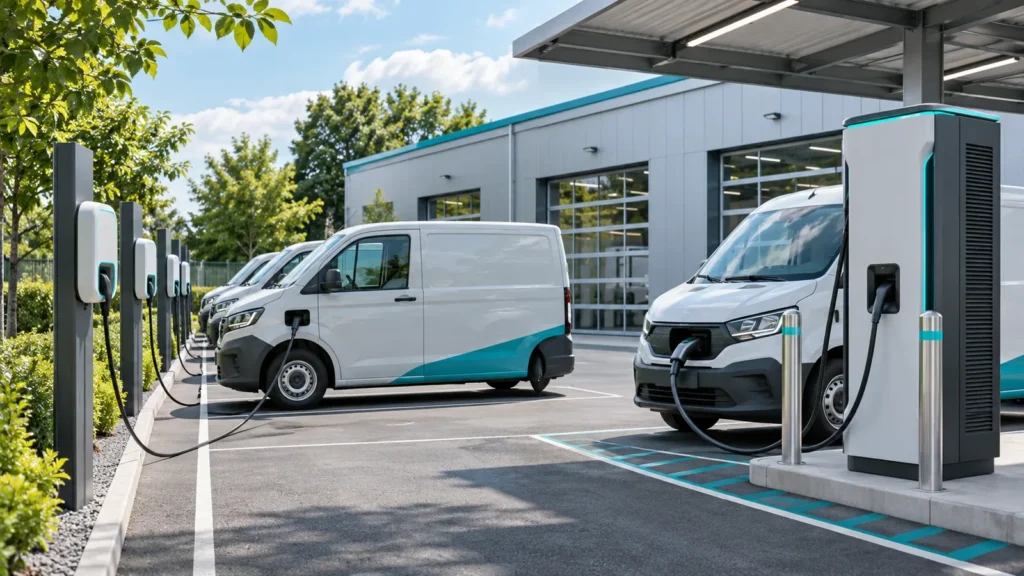
- Overnight depots and homes: 7 kW is usually enough for vans and cars parked eight hours or more; see how many EV chargers a fleet needs.
- Workplaces: 7 kW, or 22 kW where three-phase power is available and vehicles can use it.
- Retail and leisure: 50 kW for stays of around an hour, or higher where drivers stop briefly.
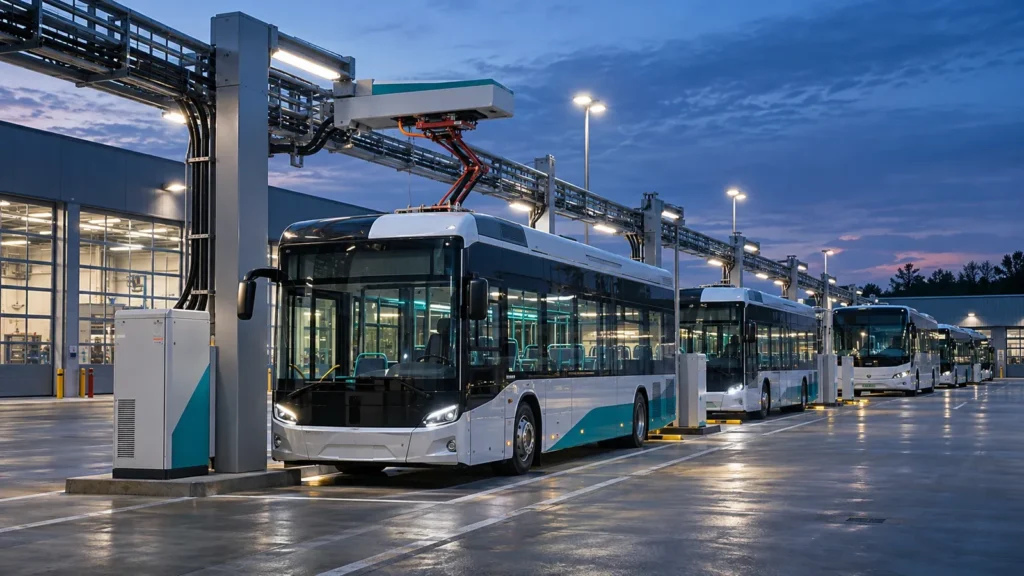
- Hubs and busy routes: 150 kW and above, often with power sharing; see planning an ultra-fast charging hub. Hyundai, for example, defines ultra-fast charging as 150–350 kW.
Higher power needs more grid capacity and costs more to buy and install, so match it to real need. For the AC and DC trade-offs at depots, see AC vs DC charging.
Frequently asked questions
Is a 22 kW charger always faster than 7 kW?
Only if the site has three-phase power and the vehicle’s on-board charger can accept more than 7 kW. Otherwise it charges at the vehicle’s limit.
Can I install 22 kW chargers on a single-phase supply?
No. 22 kW AC needs a three-phase supply. Check what your site has before choosing.
What is a 50 kW charger good for?
Top-ups during stays of around an hour, and vehicles that need more than an overnight AC charge can give.
Our solution recommendations service matches charger power to your vehicles, site and budget. Tell us about your site.