In short: for vehicles parked overnight, AC charging is usually the better choice for a depot: cheaper to buy, install and maintain, and easier on the grid connection. DC charging earns its place where vehicles have short turnarounds, run double shifts or carry large batteries that AC cannot fill in time. Most depots end up with a mix: AC for the many, DC for the few vehicles that need it.
Choosing between AC and DC is one of the first decisions in a depot project, and one of the most expensive to get wrong. This article explains the difference and how to decide.
What is the difference?
Batteries store DC power, but the grid supplies AC. Something has to convert it.
- AC charging: the charger supplies AC and the vehicle’s on-board charger converts it. Power is limited by the on-board charger, so AC is slower.
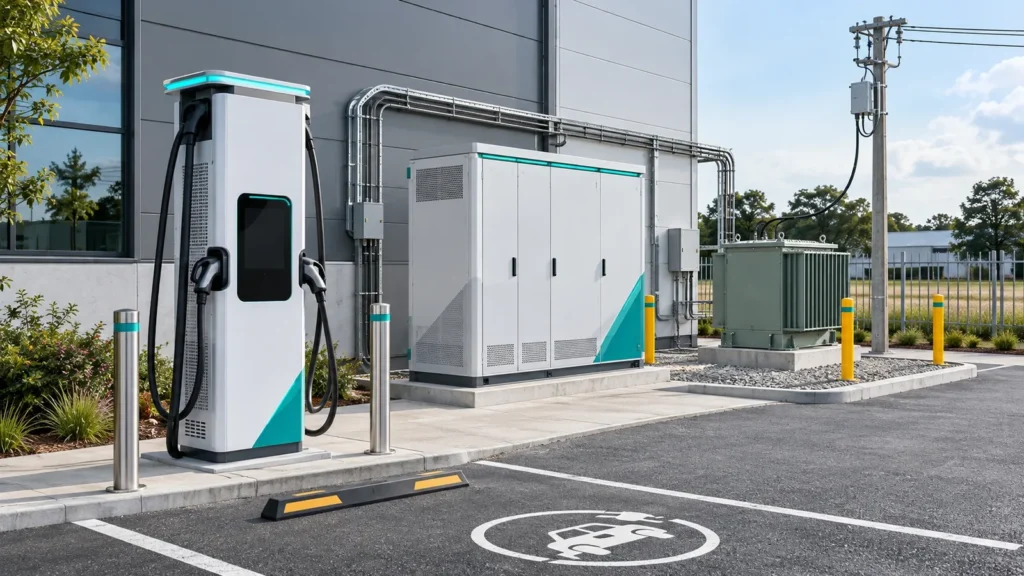
- DC charging: the charger converts AC to DC itself and feeds the battery directly, allowing much higher power.
Our EV charging glossary explains the related terms.
How do they compare for a depot?
| Factor | AC | DC |
|---|---|---|
| Charging speed | Slower, limited by the vehicle’s on-board charger | Much faster, limited by charger and vehicle |
| Hardware cost | Low | High |
| Installation | Simpler: smaller cables, wall or post mounting | Heavier: larger cables, foundations, more space |
| Grid capacity per charger | Low | High |
| Maintenance | Simple, few moving parts | More complex, with cooling and power modules |
| UK smart charging rules | In scope for private car and van chargers | Rapid chargers of 50 kW and above are outside their scope |
The smart charging rules are set out in the Smart Charge Points Regulations, which apply to private charge points for cars and vans other than public and rapid ones.
When is AC the right choice?
- Vehicles are parked for eight hours or more, usually overnight.
- Daily energy needs fit within what the vehicle’s on-board charger can deliver in that time.
- The grid connection is limited, so many low-power chargers sharing capacity work better than a few high-power ones. A flexible connection may also give an earlier power-on date.
Our worked example on how many EV chargers a fleet needs shows how quickly overnight AC can cover a typical van fleet.
When do you need DC?
- Vehicles run double shifts or have short breaks between duties.
- Batteries are too large for AC to fill overnight, as with many buses and trucks. For the largest vehicles, the Megawatt Charging System is designed for up to 1,250 V and 3,000 A DC.
- A vehicle returns unexpectedly low and must leave again soon.
- The vehicle’s on-board charger is too small for the energy it needs.
Where DC is needed for several bays, a distributed system that shares power between dispensers can be more efficient than standalone units; see distributed vs standalone chargers.
Why most depots use both
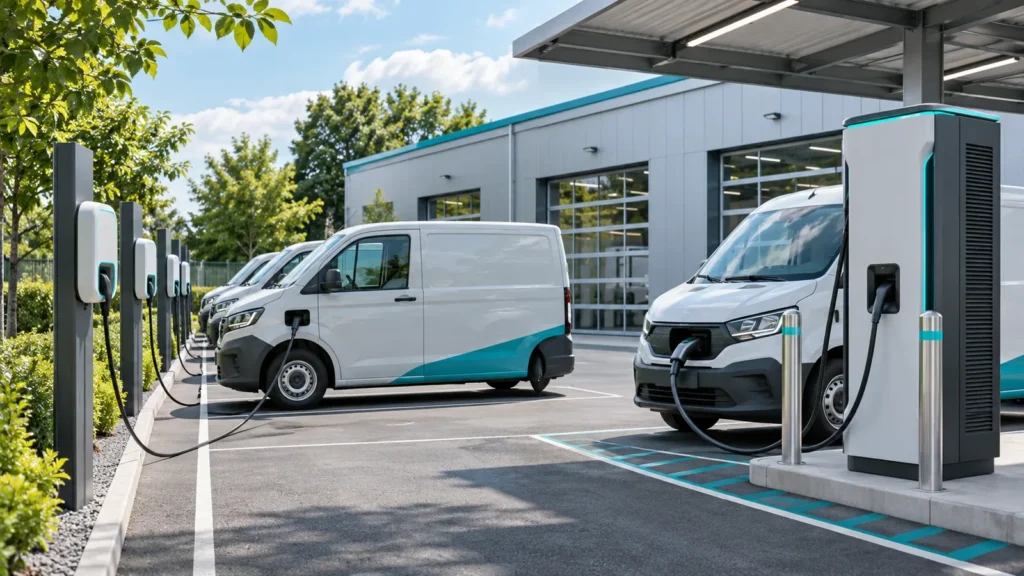
A common pattern is AC chargers at every bay for overnight charging, plus one or two shared DC chargers for top-ups and exceptions. This keeps capital and grid costs down while giving operations a safety net. Plan the DC chargers’ location so vehicles can reach them without blocking the yard.
Questions to answer before you decide
| Question | Points towards |
|---|---|
| Are vehicles parked 8 hours or more? | AC |
| Do any run double shifts? | Some DC |
| How large are the batteries? | Large batteries favour DC |
| How much spare grid capacity is there? | Little capacity favours AC with load management |
| What is the on-board charger rating? | Low ratings limit AC |
Frequently asked questions
Is DC charging bad for vehicle batteries?
Vehicles manage their own charging power to protect the battery. For fleets, follow the manufacturer’s guidance on how often to use rapid charging.
Can I add DC chargers later?
Yes, if you plan for it. Leave space and cable routes, and check the grid capacity they will need.
Is AC charging enough for electric HGVs?
Usually not. Heavy vehicles carry large batteries and typically need DC; see electric HGV charging.
Our solution recommendations service sets the AC and DC mix from your duty cycles. Tell us about your fleet.