In short: mobile energy storage is a battery system that can be moved to where power is needed: on a trailer, in a container or on a skid. It stores electricity from the grid or from solar, then supplies it to tools, cabins, events, vehicles or buildings without a fixed connection. It is replacing diesel generators on many temporary sites because it is quiet, produces no exhaust on site and runs efficiently at low loads.
For decades, power away from the grid meant a diesel generator. Battery technology has changed that. Mobile energy storage systems now power construction sites, festivals, film sets and emergency operations, and charge electric vehicles where no charger exists. Here is what they are, how they work and what to look for.
What is mobile energy storage?
A mobile energy storage system is a battery, an inverter and controls in a package designed to be moved. It is charged where power is available and then delivers that power somewhere else, or it sits on site and is topped up periodically.
Common forms include:
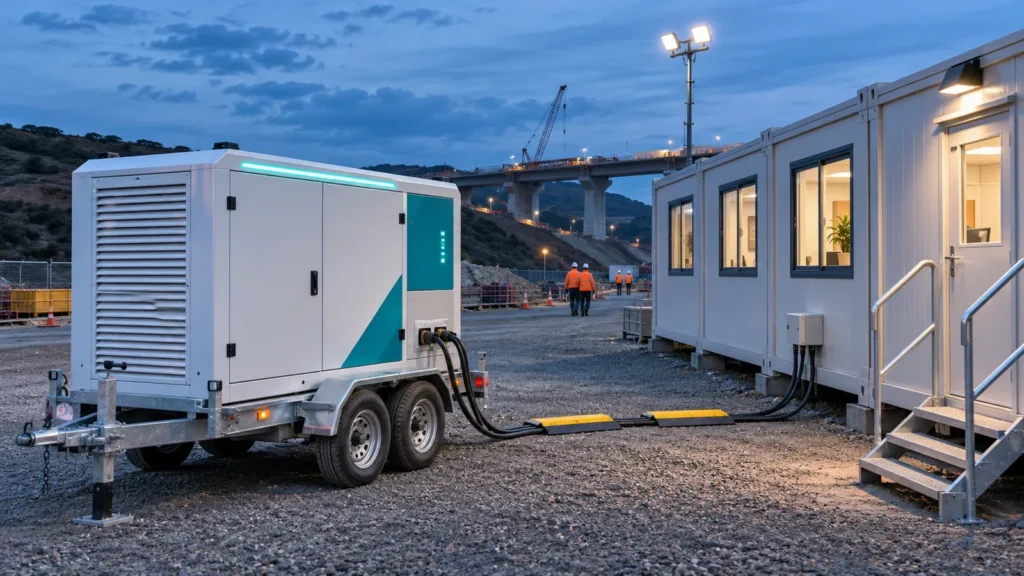
- Trailer units that can be towed between sites
- Containerised systems moved by lorry for larger loads
- Skid-mounted units moved by forklift or crane
- Portable units small enough to wheel by hand, for light loads
What is it used for?
- Construction sites: cabins, lighting, tools and security, especially overnight
- Events and film sets: silent power close to audiences and microphones
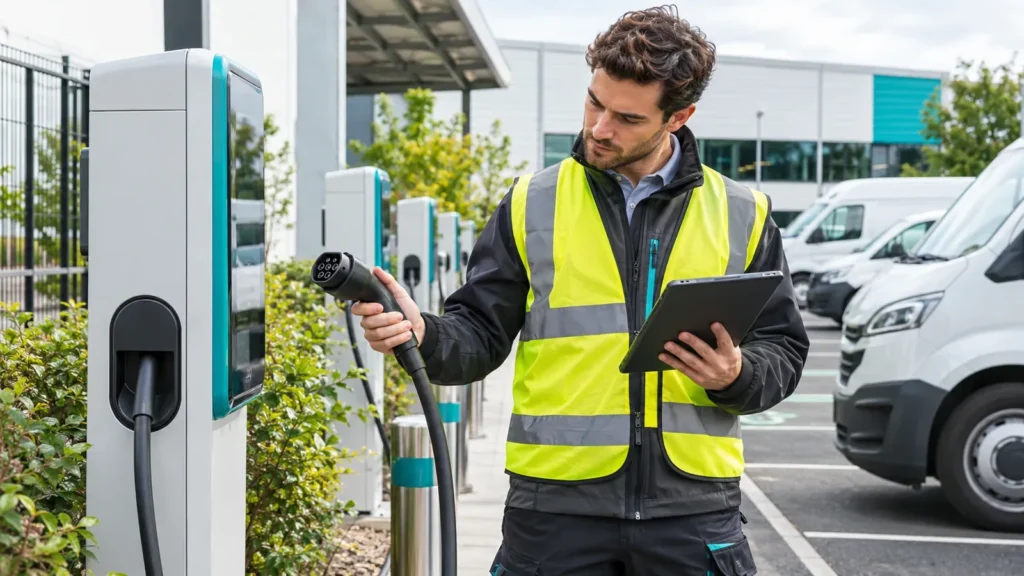
- EV charging: charging vehicles at depots waiting for a grid connection, at events or at the roadside. See our guide to mobile EV charging.
- Backup power: keeping essential equipment running during outages or works
- Grid support: adding capacity where a site’s supply is temporarily too small
Why is it replacing diesel?
Diesel costs more than it did
From 1 April 2022, most sectors, including construction, lost the right to use rebated red diesel, so sites now pay the full rate of duty on generator fuel.
Emissions rules are tightening
In London, rules for non-road mobile machinery apply to engines from 37 kW to 560 kW. Generators must already meet the Stage V standard, the wider standard rises to Stage V across London from 1 January 2030, and only zero-emission machinery will be allowed from 1 January 2040.
Batteries suit real site loads
Generators are usually sized for the peak but spend most hours lightly loaded, which wastes fuel. A battery is efficient at any load. Paired with a smaller generator as a hybrid, savings can be large: a Purdue University study found that a right-sized battery-diesel generator system allows for more than 50% cost savings compared with a generator alone, in modelling. Our comparison of battery power units and diesel generators covers this in more detail.
The specifications that matter
| Specification | What it tells you |
|---|---|
| Usable energy (kWh) | How long it can run your loads |
| Continuous output (kW) | How much it can power at once |
| Peak or surge output | Whether it can start motors and heavy tools |
| Outputs | Single- or three-phase AC, and DC connectors for EV charging if needed |
| Recharge time and supply | How quickly it refills, and from what |
| Weight and transport | Who can move it, and how |
| Monitoring | Remote view of charge level and load |
Sizes vary widely. One manufacturer’s mobile charging trailer range, listed by Tursan, runs from 30 kW with 30 kWh up to 200 kW with 200 kWh. Larger containerised systems go well beyond that.
How do you move it?
Batteries are heavy, so check the laden weight before you plan transport. GOV.UK guidance says drivers who passed their car test from 1 January 1997 can drive a car or van up to 3,500 kg maximum authorised mass towing a trailer of up to 3,500 kg. Heavier units need a different licence or a lorry. Ask suppliers too how they handle the transport rules for large lithium batteries.
Frequently asked questions
Is mobile energy storage the same as a portable power station?
Portable power stations are small consumer units for light loads. Mobile energy storage usually means larger systems for commercial sites, measured in tens or hundreds of kWh.
How is it recharged?
From a grid supply, a site connection, solar panels, or in a hybrid setup, a generator that runs only when needed at an efficient load.
Should I hire or buy?
Hire for a one-off or a known short period. Buy when the need recurs across sites or events and you can keep the unit busy.
Choosing the right mix of storage, generation and grid power is part of our solution recommendations service. For fixed sites, see why battery-boosted charging matters. Tell us what you need to power.