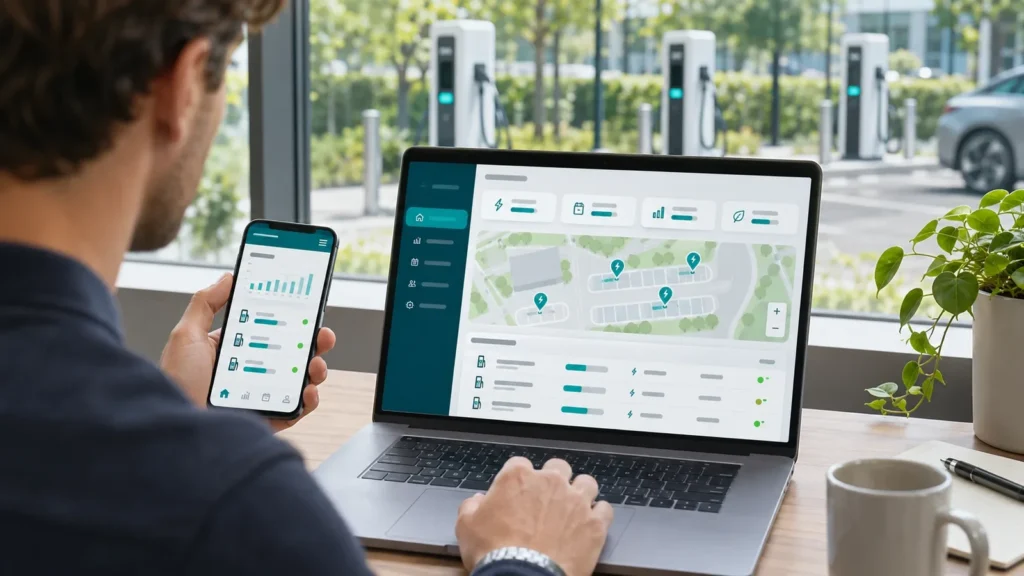
In short: charge point management software, often called the back office or CPMS, controls who can charge, how much they pay, how power is shared and how faults are reported. Choose it on the jobs you need done, not the feature list: access and payment, load management, reporting, integration with your other systems and support. Insist on OCPP so you can change software without replacing chargers, and make sure you own your data.
Chargers are hardware; most of what users experience comes from software. The right management platform can make a modest set of chargers run well, and the wrong one can make good hardware frustrating. This guide covers what to look for. You will see it called EV charging station management software, charge point management software or back office software; all mean the platform that runs your chargers.
What does the software do?
- Access: who can charge, using cards, apps or vehicle identification.
- Payment and tariffs: free, pay per kWh, or different prices for staff, visitors and the public.
- Load management: sharing the site’s capacity between chargers.
- Monitoring: charger status, faults and remote resets.
- Reporting: energy, sessions, costs and uptime.
- Integration: with fleet systems, billing, building energy management or roaming networks.
Start with your use case
| Site type | Software priorities |
|---|---|
| Fleet depot | Load management, departure-time priorities, energy per vehicle, fleet system integration |
| Workplace | Access control, staff tariffs, simple reporting |
| Public charging | Payment, roaming, open data and reliability reporting to meet public charging rules |
| Mixed site | Different rules and priorities for each user group |
For public charge points, the software must help you meet the Public Charge Point Regulations 2023, including open data and, for rapid networks, reliability reporting.
Why does OCPP matter?
OCPP is the open protocol chargers use to talk to management software. With it, you can choose hardware and software separately and change either later. Check which version the software supports: the Open Charge Alliance notes that OCPP 1.6 and OCPP 2.0.1 are not compatible, so your chargers and software must speak the same version. Our guide to OCPP for charger buyers explains the versions.
If you want drivers from other networks to use your chargers, or your drivers to use theirs, ask about roaming. That runs over a separate protocol, OCPI, which the EVRoaming Foundation describes as supporting connections between e-mobility service providers and charge point operators.
What should you ask suppliers?
- Which OCPP versions and features do you support, and with which charger brands is that proven in live service?
- How does load management work, and does it enforce the site limit locally if the internet drops?
- Can we export all session, energy and fault data in a standard format, at any time?
- How are prices set per charger, and how can they change?
- What are your support hours and response times?
- What happens to our chargers and data if we leave?
Contract points
- Data ownership: you own your data and can take it with you.
- No lock-in: no fees or remote restrictions on moving chargers to another platform.
- Price stability: fixed or capped fees for a defined period.
- Service levels: platform availability and support response, with remedies.
Our guide to charger uptime and service levels covers how to write those terms.
Frequently asked questions
Should the software come from the charger manufacturer?
It can, but choose it on merit. With OCPP chargers, the best software for your use may come from another supplier.
How hard is it to switch platform?
With OCPP chargers and a contract that allows it, switching is usually a configuration change. Without those, it can mean new hardware.
Do I need roaming?
Only if outside drivers will use your chargers, or your drivers need access to other networks.
Our procurement and supplier selection service tests software against your real use case before you commit. Tell us what you need it to do.