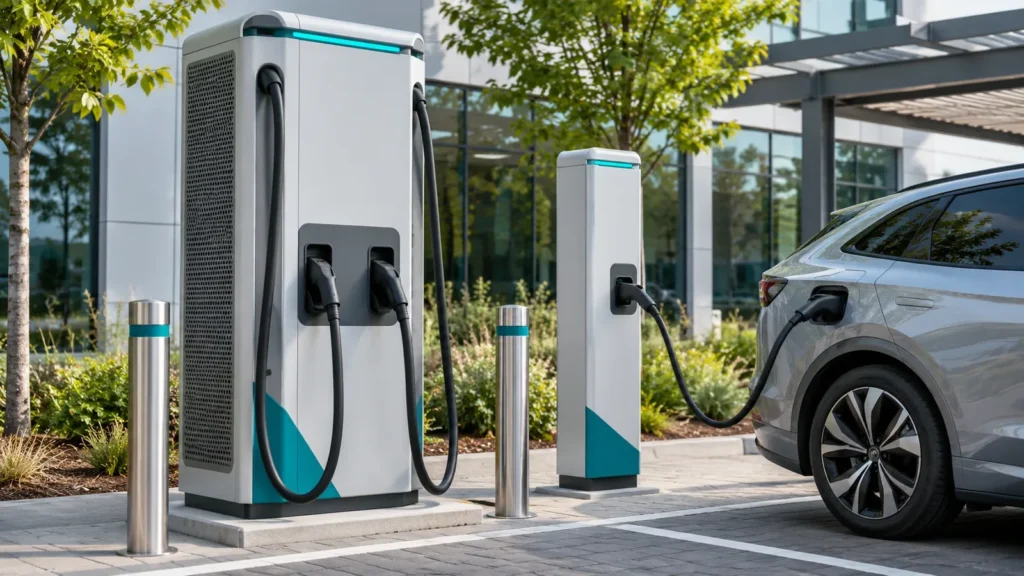
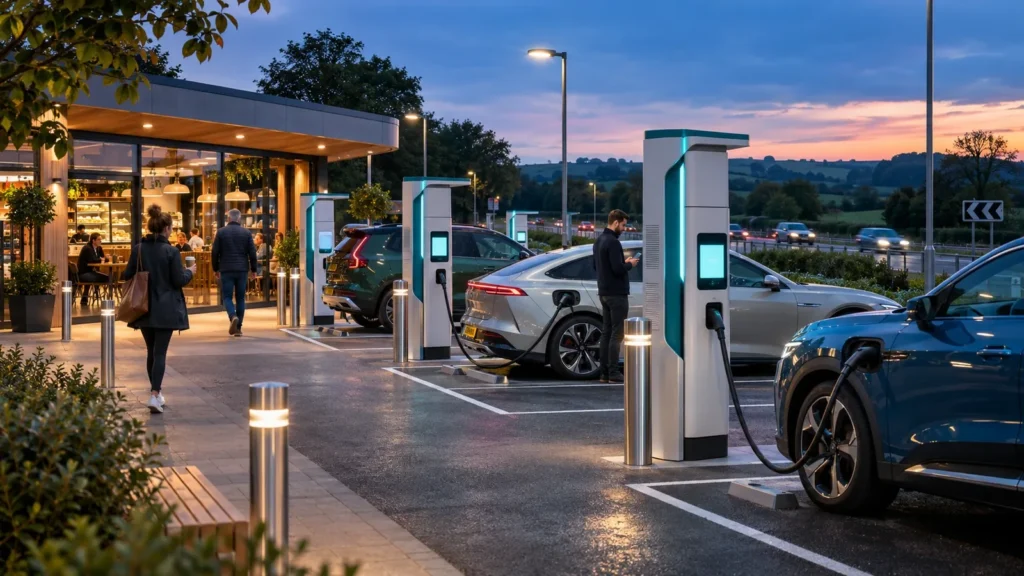
In short: are EV charging hubs profitable? A hub makes money when it sells enough energy at a healthy margin to cover its running costs and pay back a large upfront investment. Utilisation, how much energy each charger sells, matters more than anything else, followed by the margin per kWh and the cost of the grid connection. A hub can be very profitable in the right place and loss-making in the wrong one, so model your own site carefully before investing.
Charging hubs are expensive to build, and their returns depend on things you only partly control: how many drivers stop, how long they stay and what electricity costs. This article sets out how the economics work and how to test a site.
Where does the money come from?
- Energy sales: the price drivers pay per kWh, minus what the electricity costs you.
- Site revenue: for retailers and hospitality, the extra spend from drivers who stop to charge.
- Other income: idle fees for vehicles left plugged in, fleet contracts, or flexibility services where a battery is installed.
Public hubs must show the price in pence per kWh. The Public Charge Point Regulations 2023 require the total price to be clearly displayed in pence per kWh, and say it must not increase once charging has started.
Where does it go?
| Cost | What drives it |
|---|---|
| Chargers and installation | Number and power of chargers, groundworks, canopy |
| Grid connection | Size of connection, distance to capacity, reinforcement |
| Electricity | Energy price, network charges, time of day |
| Software and payment | Platform fees, card and app transaction fees |
| Maintenance and support | Service contract, spares, 24-hour helpline |
| Site costs | Rent or revenue share, business rates, insurance, lighting, security |
The grid connection can be the biggest single cost. Sizing it carefully pays: in one Devon example, a charging hub that reapplied for a better-sized connection saved over £1 million and was energised three years sooner, Vattenfall reported.
A worked example
The figures below are illustrative assumptions for a six-charger hub, to show how the economics behave. They are not market prices; replace each one with your own.
| Illustrative assumption | Base case | Busier site |
|---|---|---|
| Energy sold per charger per day | 300 kWh | 450 kWh |
| Energy sold per year (6 chargers) | 657,000 kWh | 985,500 kWh |
| Margin per kWh after energy and fees | 25p | 25p |
| Gross margin per year | £164,250 | £246,375 |
| Running costs per year | £60,000 | £60,000 |
| Net per year | £104,250 | £186,375 |
| Build cost including connection | £900,000 | £900,000 |
| Simple payback | About 8.6 years | About 4.8 years |
Selling 50% more energy from the same hardware nearly halves the payback period, because the running costs barely change. That is why location and utilisation dominate hub economics. Test your own figures with our EV charging hub payback calculator.
What makes a site profitable?
- Traffic and dwell: enough passing drivers, and a reason to stop, such as food, shopping or a natural break in a journey.
- Charger power matched to visitors: very high power only pays where vehicles can use it; see 150 kW vs 350 kW chargers.
- Affordable grid capacity: or a battery to make a smaller connection work; see battery storage vs a grid upgrade.
- Reliability: drivers avoid sites that fail. Rapid networks must meet a 99% reliability requirement, and lost sessions are lost revenue; see charger uptime and service levels. In a Monta survey of more than 200 operators, 56% named the 99% rule their greatest challenge.
- Competition: nearby hubs affect both utilisation and the price you can charge.
For layout and bay numbers, see our guide to planning an ultra-fast charging hub.
Which business model?
| Model | Site owner’s role | Risk and return |
|---|---|---|
| Own and operate | Invests and runs the hub | Highest risk, all the margin |
| Own, outsource operation | Invests; an operator runs it for a fee | High risk, most of the margin |
| Lease or revenue share | Provides the land; an operator invests | Low risk, a share of income |
| Fleet anchor plus public | A fleet contract covers base demand, the public fills gaps | Lower risk, steadier income |
Frequently asked questions
Are EV charging hubs profitable?
They can be, where utilisation is high enough to cover running costs and pay back the build cost. The same hub can lose money in a quiet location, so model the site before investing.
What utilisation do I need?
It depends on your build cost, margin and running costs. Work out the energy you need to sell each day to break even, then test whether the site can realistically deliver it.
Should a landowner build their own hub?
Only if they are comfortable with the investment and operating risk. A lease or revenue share with an operator gives lower but steadier returns.
Our market entry strategy service models hub sites and business cases. Tell us about your site.