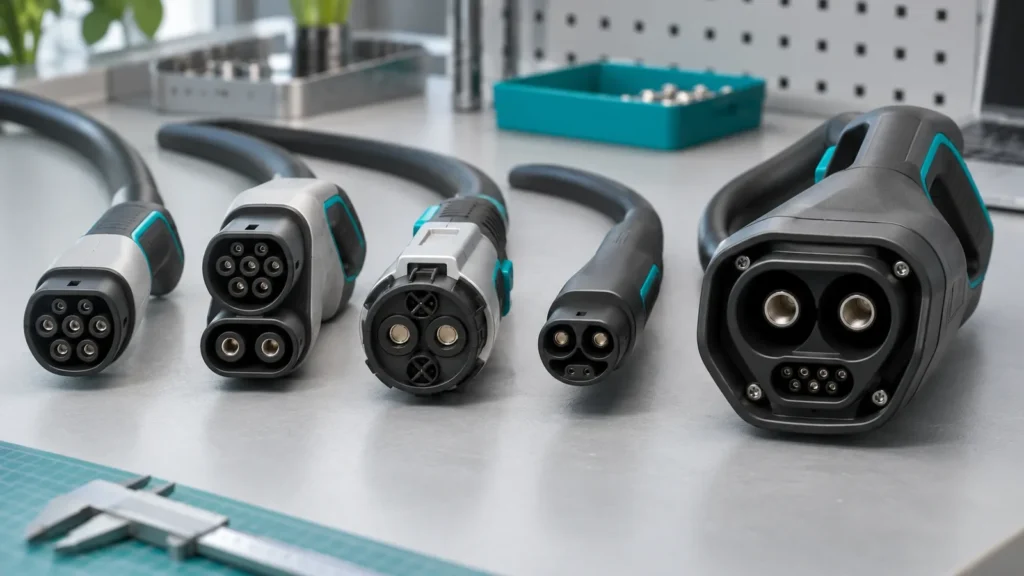
In short: in the UK and Europe, most electric cars and vans use a Type 2 connector for AC charging and CCS2 for DC rapid charging, so those two cover most sites. CHAdeMO is an older DC standard now found on fewer new vehicles. North America is moving to the NACS connector, standardised as SAE J3400, alongside CCS1. Heavy trucks will use the Megawatt Charging System. Check the vehicles you run and expect to buy before choosing chargers.
Connector choice decides which vehicles can use a charger. Getting it wrong means chargers that sit idle or need adapters. This guide explains the main connectors and which to choose.
Which connectors are in use?
| Connector | AC or DC | Where it is used |
|---|---|---|
| Type 2 | AC | Standard AC connector for cars and vans in the UK and Europe |
| CCS2 (Combined Charging System) | DC | Type 2 plus two DC pins; the common DC connector in the UK and Europe |
| Type 1 | AC | Older AC connector, mainly on early vehicles from North America and Asia |
| CCS1 | DC | North American version of CCS |
| CHAdeMO | DC | Older DC standard, now on fewer new vehicles in Europe |
| NACS (SAE J3400) | AC and DC | Connector developed by Tesla, now being adopted across North America |
| MCS (Megawatt Charging System) | DC | Very high power charging for heavy trucks |
Type 2 and CCS2: the UK default
For most UK sites, Type 2 for AC and CCS2 for DC cover the vehicles you will see. CCS adds two large DC pins below a Type 2-style head, which is why the same vehicle inlet accepts both. Most AC chargers at workplaces and depots offer a Type 2 socket or a tethered Type 2 cable. Our glossary explains the related terms.
Is CHAdeMO still worth offering?
CHAdeMO is a DC charging standard for electric vehicles, and its organisation highlights its support for bidirectional charging, such as vehicle-to-grid. It now appears on fewer new vehicles in Europe, but some older vehicles still in service rely on it. Public sites may keep one CHAdeMO cable for those drivers; fleet depots usually only need it if their vehicles use it. For bidirectional charging more generally, see V2G for fleets.
What about NACS and North America?
The North American Charging Standard was developed by Tesla and standardised through SAE as J3400. The US Joint Office of Energy and Transportation notes that SAE released a J3400 technical report in December 2023 and affirmed it as a recommended practice in September 2024. CCS1 remains in wide use there. If you sell or install chargers in the US, see our guide to selling EV chargers in the US.
What will heavy trucks use?
The Megawatt Charging System is a separate standard for heavy vehicles. CharIN lists its limits as up to 1,250 volts and 3,000 amps DC. Until MCS is widespread, many electric trucks charge with CCS at depots. See electric HGV charging.
How do you choose connectors for a site?
- List your vehicles, current and planned, and their AC and DC inlets.
- For public sites, cover the vehicles most drivers use; in the UK that means Type 2 and CCS2.
- Decide tethered or socketed AC. Tethered cables are convenient; sockets let drivers use their own cable and suit mixed fleets.
- Plan for change. Ask whether connectors and cables can be swapped later without replacing the charger.
Frequently asked questions
Do all UK electric cars use Type 2?
Most current cars and vans in the UK use Type 2 for AC charging. Some older vehicles use Type 1, so check if you have any in your fleet.
What is the difference between CCS and CCS2?
CCS is the overall system. CCS2 is the version based on the Type 2 connector used in Europe and the UK; CCS1 is the North American version.
Can adapters solve connector mismatches?
Sometimes, but they add cost and risk. Choose chargers with the right connectors for your vehicles where possible.
Our solution recommendations service specifies chargers and connectors to match your vehicles. Tell us about your fleet.