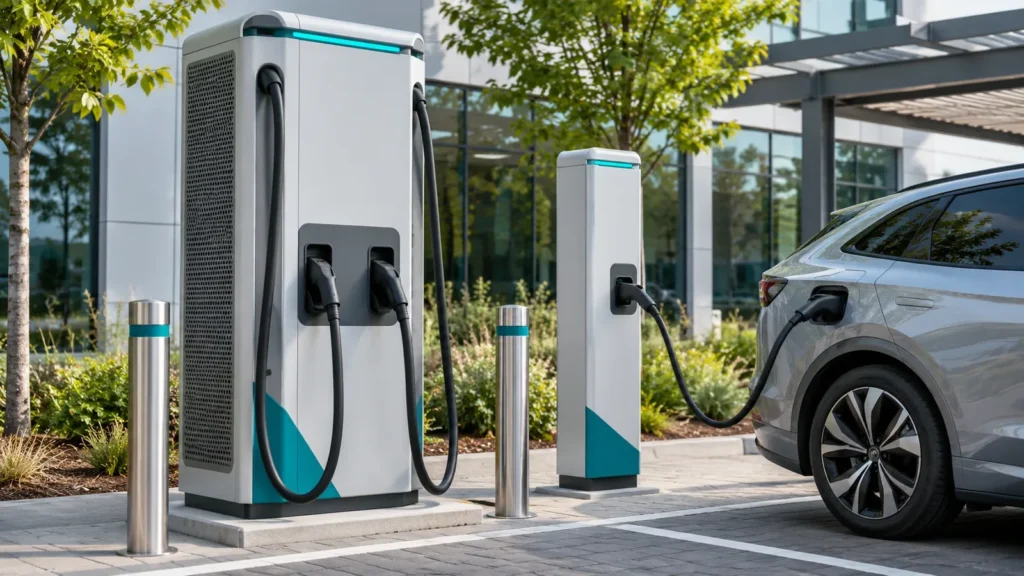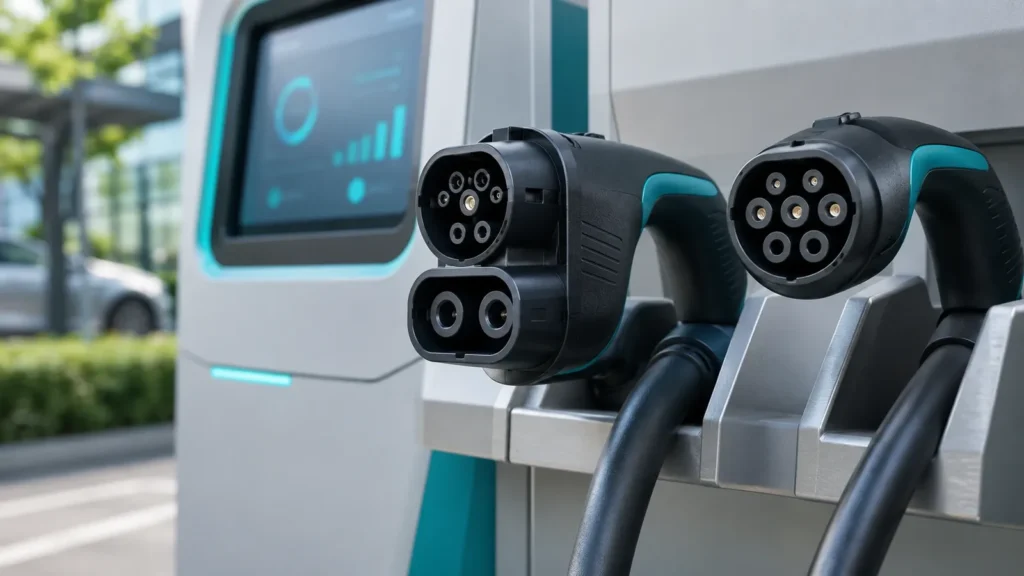
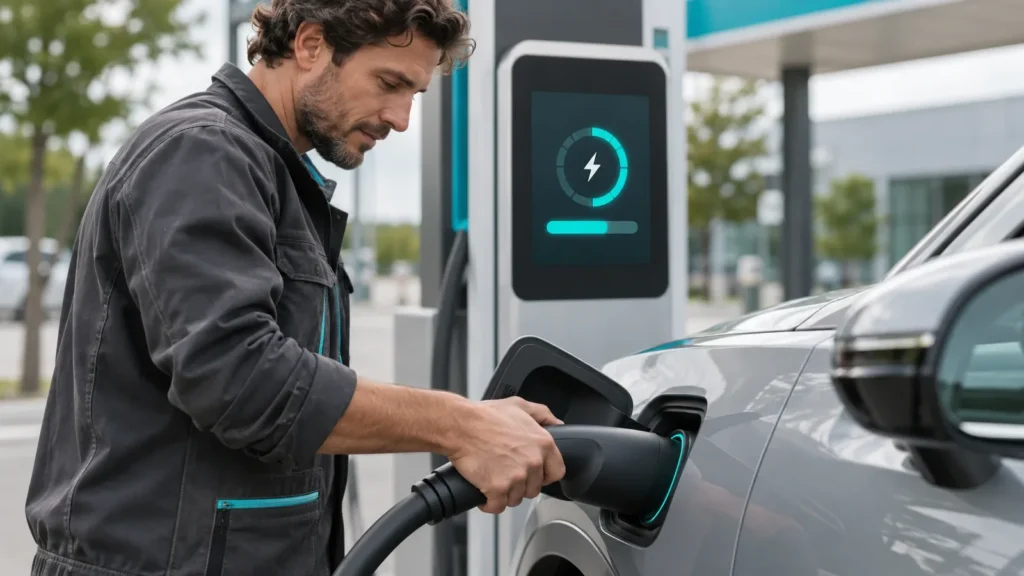
In short: DC fast charging converts power to DC inside the charger and feeds it straight to the vehicle’s battery, so it can charge far faster than AC. In Great Britain, charge points of 50 kW and above count as rapid under the public charging rules, and ultra-fast chargers run from about 150 kW upwards. DC fast chargers suit short stops, busy hubs and fleets with tight turnarounds. They cost more and need more grid capacity, so use them where time matters.
Fast charging is what makes long journeys and busy fleets work with electric vehicles. This guide explains how DC fast charging works, its power levels and when a site needs it.
How does DC fast charging work?
Batteries store DC power, but the grid supplies AC. With AC charging, the vehicle’s on-board charger converts it, which limits power. With DC charging, the charger does the conversion with much larger power electronics and supplies DC directly to the battery. The vehicle still controls how much power it accepts, through its battery management system.
For the full comparison, see AC vs DC charging.
What power levels are there?
| Level | Typical power | Typical use |
|---|---|---|
| Rapid | 50 kW and above | Retail, hospitality, depot top-ups |
| Ultra-fast or high-power | About 150 kW to 350 kW | Motorway hubs, busy urban hubs, fleets with short stops |
| Megawatt | Megawatt scale | Heavy trucks on long routes |
The Public Charge Point Regulations 2023 define a rapid charge point as a public charge point of 50 kW or above. Hyundai, for example, defines ultra-fast charging as power in the range of 150 kW to 350 kW. For heavy vehicles, see electric HGV charging.
Why doesn’t charging stay at full power?
DC charging power usually falls as the battery fills, to protect it. IONITY notes that charging from 80% to 100% takes just as long as from 20% to 80%. The vehicle also sets its own maximum, which varies widely between models. That is why a higher-power charger only helps vehicles that can use it; see 150 kW vs 350 kW chargers and choosing charger power.
Which connectors do DC chargers use?
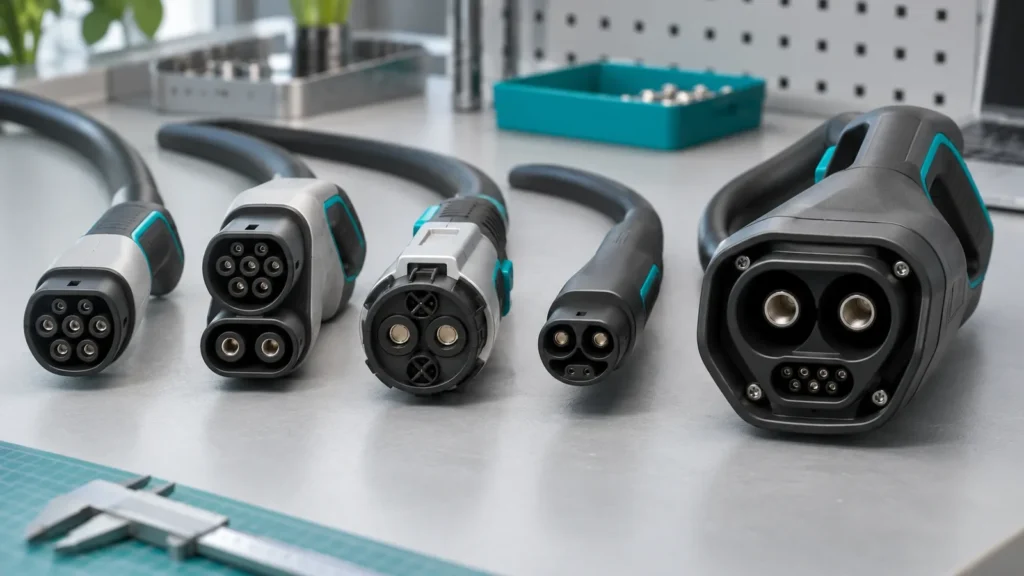
In the UK and Europe, CCS2 is the common DC connector. Some older vehicles use CHAdeMO, and North America is moving to the NACS connector alongside CCS1. Our guide to EV connector types explains each one.
When does a site need DC fast charging?
- Short stops: drivers who stay minutes rather than hours, such as on major routes or at hubs.
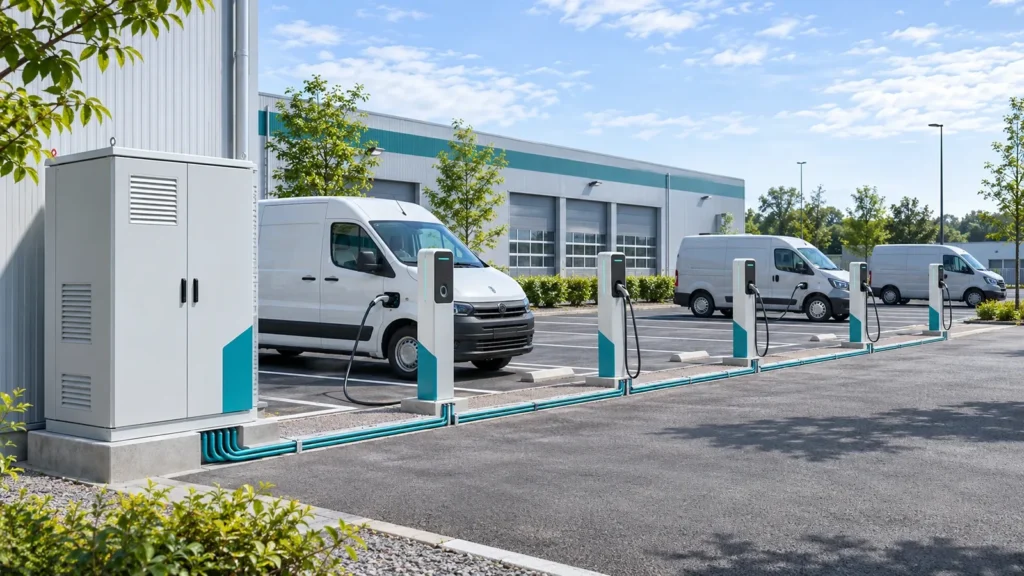
- Fleets with tight turnarounds: vehicles running double shifts or returning briefly between duties.
- Large batteries: buses and trucks that AC cannot fill in the time available.
- Retail and hospitality: where a stop of around an hour should add a useful amount of range.
For overnight parking, AC is usually enough and much cheaper. Where DC is needed on a limited grid connection, battery-buffered chargers or shared-power systems can help; see battery-integrated fast charging.
What do public DC chargers have to provide?
Public rapid chargers must meet the public charging rules, including contactless payment, prices in pence per kWh, a free 24-hour helpline and, across a rapid network, 99% reliability. See EV charging regulations for site owners.
Frequently asked questions
Is DC fast charging bad for batteries?
Vehicles manage charging power to protect their batteries. Fleets should follow the manufacturer’s guidance on how often to rapid charge.
What is the difference between rapid and ultra-fast?
In GB public charging rules, rapid means 50 kW or more. Ultra-fast usually describes chargers from about 150 kW upwards.
Do I need DC chargers at my depot?
Only for vehicles that cannot get enough energy from AC in the time they are parked. Most overnight depots need only a few, if any.
Our solution recommendations service decides where DC fast charging pays its way. Tell us about your site.