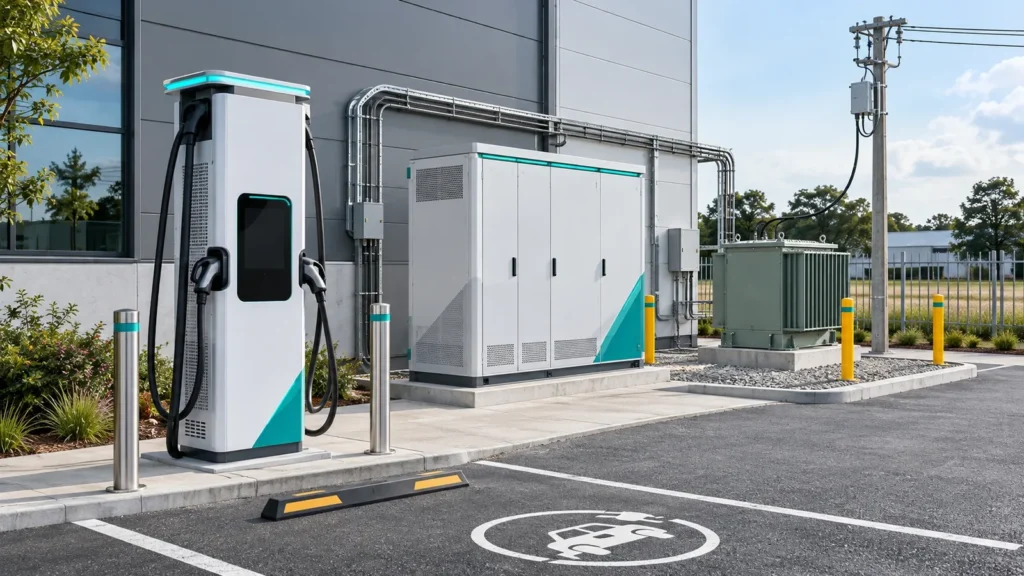
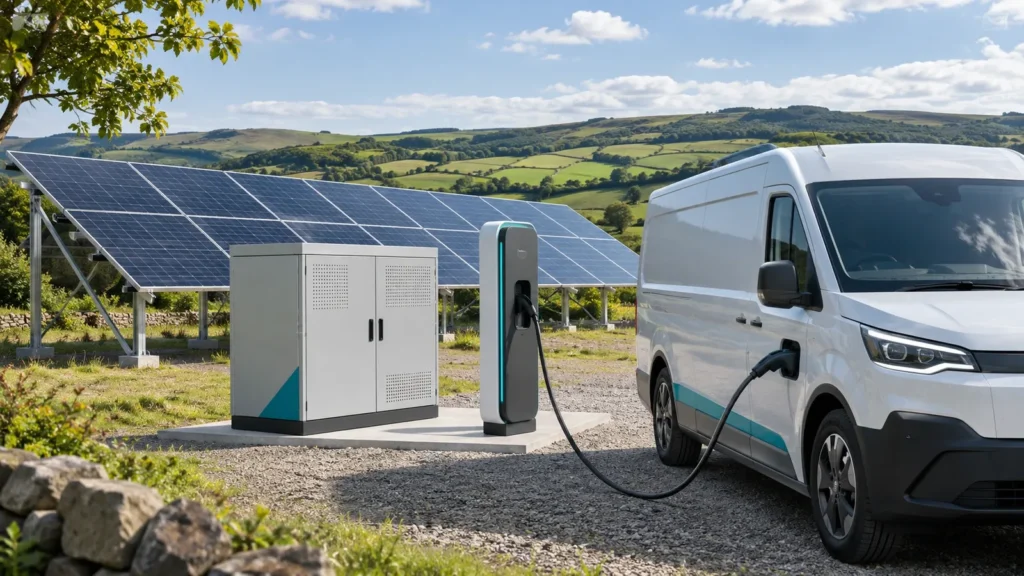
In short: off-grid EV charging means charging vehicles without a connection to the electricity grid, using solar panels, batteries, mobile charging units or a mix of all three. It works best where demand is modest and predictable, such as remote sites, temporary sites and rural car parks. In the UK, solar output falls sharply in winter, so most off-grid systems need a large battery, a backup supply or both. Size the system from vehicle energy needs first, not from panel numbers.
Off-grid charging appeals where a grid connection is slow, expensive or impossible. It is not a free lunch: without the grid behind it, every kWh has to be generated or delivered, stored and managed on site. This guide covers the options, how to size them and where they make sense in the UK.
What are the off-grid options?
| Option | How it works | Best for |
|---|---|---|
| Solar plus battery | Panels charge a battery; the battery supplies the chargers | Permanent remote sites with modest, steady demand |
| Mobile charging units | Battery units recharged elsewhere and brought to site | Temporary sites, events, sites waiting for power |
| Battery power units | Transportable batteries power chargers and other loads | Construction and events that also need site power |
| Hybrid with a generator | Battery handles most demand; a generator covers shortfalls | Sites with high or unpredictable demand |
Mobile units are often the simplest route: the energy comes from a grid supply elsewhere and is moved to the vehicles. See how mobile EV charging works and mobile power for site loads.
How do you size an off-grid system?
Start from the vehicles, not the panels. The illustrative example below shows the method; the numbers are assumptions, not a design.
| Illustrative assumption | Value |
|---|---|
| Vehicles charged per day | 4 vans |
| Energy per van per day | 25 kWh |
| Daily energy needed at the vehicles | 100 kWh |
| Allowance for charging and battery losses | About 15% |
| Daily energy the system must supply | About 115 kWh |
| Days of autonomy without sun | 2 |
| Usable battery energy needed | About 230 kWh |
Then check what the solar array would produce on a dull winter day, not a sunny summer one. In the UK the gap between summer and winter output is large, so an array sized for summer will fall short for months. That is why most permanent off-grid sites add a backup: a generator, scheduled deliveries from mobile units or, eventually, a grid connection.
Where does off-grid charging make sense?
- Remote and rural sites: visitor car parks, estates and farms where a connection would cost more than the demand justifies.
- Temporary sites: construction, events and filming; see temporary power supply.
- Waiting for the grid: depots that need to start before their connection arrives; see options while you wait for a grid connection.
- Light, predictable use: a few vehicles charging slowly, rather than a busy public hub.
Off-grid is rarely the right answer for busy rapid charging. High power and high utilisation need either a grid connection or a battery energy storage system topped up from one.
What else needs checking?
- Electrical design: off-grid systems still need proper design, protection and earthing to BS 7671. Use installers certified by MCS, the UK quality mark for small-scale renewables such as solar panels and battery storage.
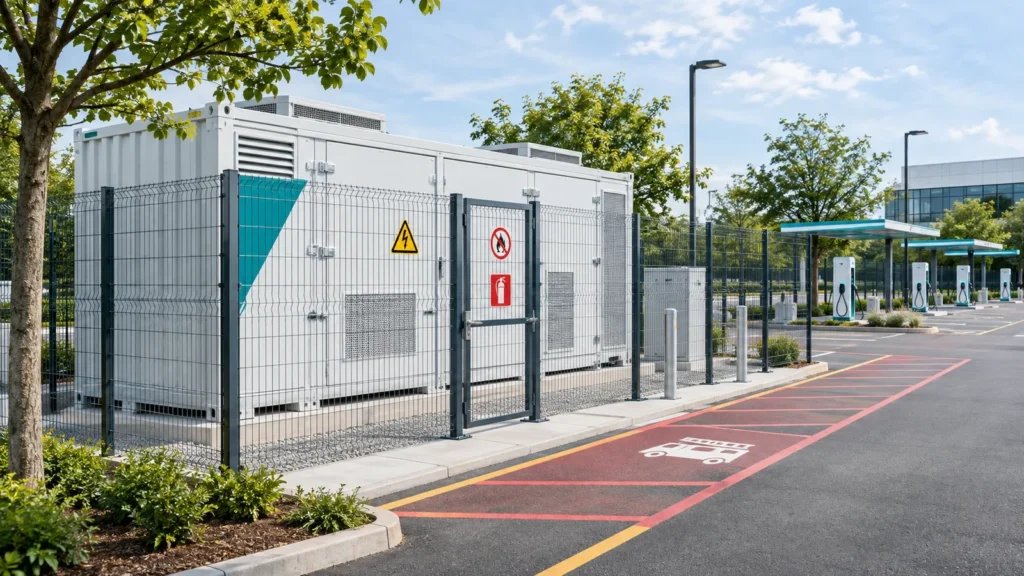
- Planning: ground-mounted panels and battery containers may need permission; see battery storage planning permission. For battery systems of 1 MWh or more, national planning guidance encourages early engagement with the fire and rescue service.
- Solar carports: a canopy can shade vehicles and generate at the same time; see solar carport EV charging.
- Monitoring: remote data on battery state and charging sessions, so problems are caught before vehicles are left uncharged.
Frequently asked questions
Can you charge an EV off-grid with solar panels alone?
Only for light use and usually not reliably through a UK winter. Most systems pair solar with a battery and a backup supply.
How big a battery does off-grid EV charging need?
Enough usable energy for daily vehicle demand plus losses, multiplied by the days you need to cover without sun. Size it from real vehicle data.
Is off-grid charging cheaper than a grid connection?
Sometimes, where a connection is very expensive and demand is modest. For busy sites a grid connection, possibly supported by storage, is usually cheaper over time.
Our solution recommendations service models off-grid, mobile and grid-connected options for your site. Tell us about your site.