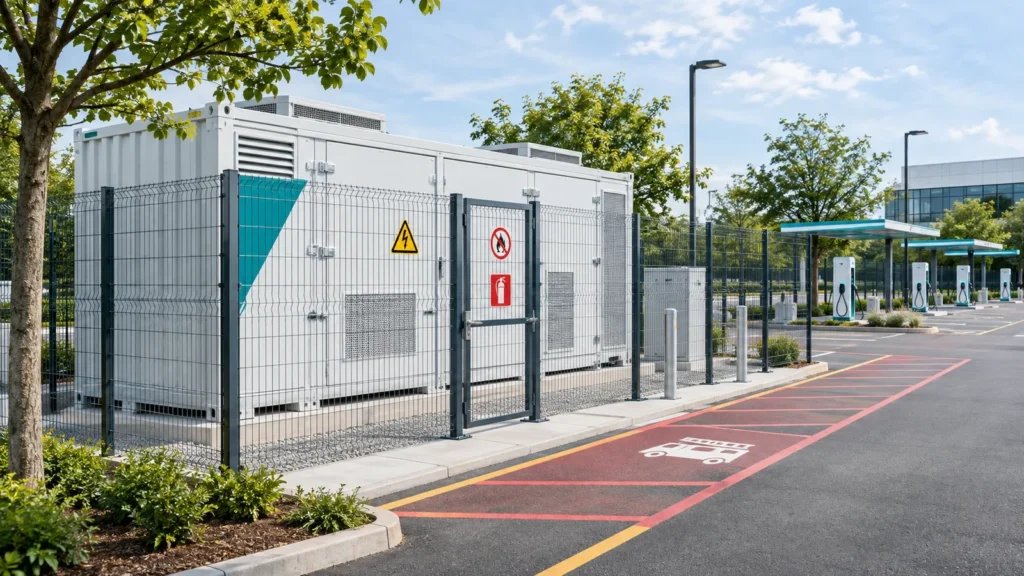
In short: battery storage at a charging site or business premises can need planning permission, network operator approval and early engagement with the fire and rescue service. In England, government planning guidance encourages applicants for systems of 1 MWh or more to speak to the local fire service before applying. Plan safety into the layout from the start: spacing, access for fire crews, ventilation and an emergency plan. Doing this early avoids redesigns and objections later.
Battery storage is increasingly paired with EV charging to get around grid limits and cut peak costs. The technical case is often straightforward. The permissions take longer than many projects allow for. This article covers the main approvals in England and what to prepare. If you are looking for the lithium-ion battery storage regulations that apply in the UK, for a charging site they come mainly from planning guidance, network operator rules and the safety evidence for the product.
Do you need planning permission?
Often, yes, especially for larger systems or containerised units. Whether you need it depends on the size and location of the system, the site’s existing permissions and local policies, so ask the local planning authority early. A short pre-application discussion is usually the quickest way to find out.
Government planning practice guidance has a dedicated section on battery storage. It says that applications for development involving lithium-ion battery energy storage systems are subject to the requirements of the Town and Country Planning (Development Management Procedure) (England) Order 2015.
When should you involve the fire and rescue service?
Before you apply, for larger systems. The same guidance says that where permission is sought for battery storage of 1 MWh or more, excluding systems at homes, applicants are encouraged to engage with the local fire and rescue service before submitting an application. That lets issues such as access for emergency services and the prevention of thermal runaway be considered early.
The guidance also encourages planning authorities to consult the fire and rescue service during the formal consultation, and points applicants to guidance from the National Fire Chiefs Council on grid-scale battery storage. Even below 1 MWh, early contact is good practice on sites with public access, such as charging hubs.
What does a fire service want to see?
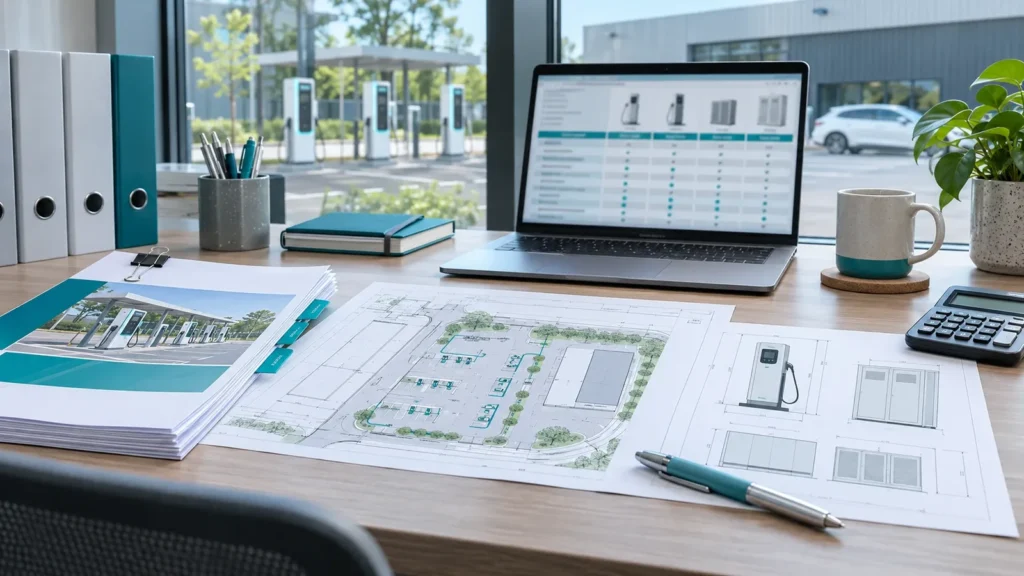
Expect questions in these areas. Prepare clear answers and drawings before the meeting.
| Area | What to prepare |
|---|---|
| Layout | Spacing between units, and distance from buildings, chargers and boundaries |
| Access | Routes for fire appliances, and where crews would set up |
| Water | Location and capacity of the nearest water supply |
| Detection and suppression | Gas and smoke detection, ventilation and any suppression system |
| Product evidence | Certification and fire test results for the system |
| Emergency plan | Isolation points, contacts, signage and how crews are informed |
Product evidence carries weight. UL 9540A is a test method for evaluating thermal runaway fire propagation in battery energy storage systems, and its results show how a fire in one cell or module is likely to spread. Ask suppliers for the full report, not just a summary. Our factory audit checklist covers how to check test reports.
Do you need network operator approval?
Yes, if the battery can export power to the grid, and you should tell the network operator about any significant storage. Storage connected to the network must meet the G98 or G99 engineering recommendations. SSEN, for example, says that for storage or generation of 50 kW or more, you need to complete a G99 application before installation, so its planners can study the network. Allow time for this alongside planning.
If the battery is there to get around a grid limit, confirm with the network operator how it will be treated. Our article on storage as a grid workaround sets out the questions to ask before you buy.
How do you keep the project on track?
- Choose the location early, with space for separation and fire access, before the rest of the layout is fixed.
- Hold a pre-application discussion with the planning authority.
- Meet the fire and rescue service with drawings and product evidence.
- Apply to the network operator in parallel, not after planning.
- Write the emergency plan before commissioning, and share it with the fire service.
- Check insurance, as insurers may have their own requirements.
For the commercial case for storage at a charging site, see battery storage vs a grid upgrade, and for contract terms, battery storage warranties.
Frequently asked questions
Is the fire service consultation a legal requirement?
The planning guidance encourages it rather than requiring it, but planning authorities are encouraged to consult the fire service, so it is wise to engage early.
Does a small battery at a charging site need any of this?
Possibly less, but check with the planning authority and network operator. Safety planning is worth doing at any size where the public is nearby.
Can storage be placed next to chargers?
It often is, but spacing and access must be agreed with the fire service and the supplier. Do not assume the closest position is acceptable.
Our solution recommendations service plans storage sites with approvals in mind from the start. Tell us about your site.