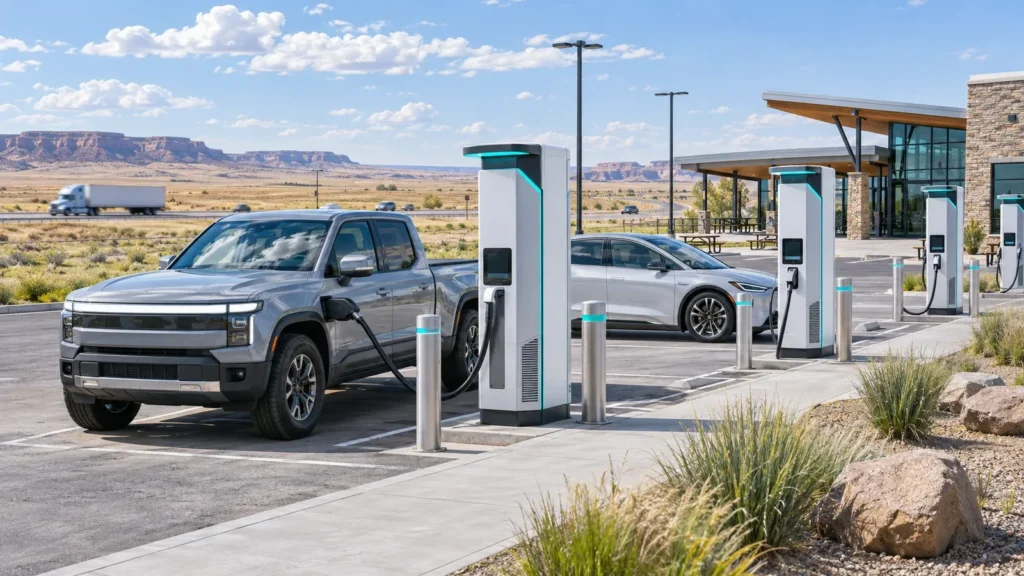
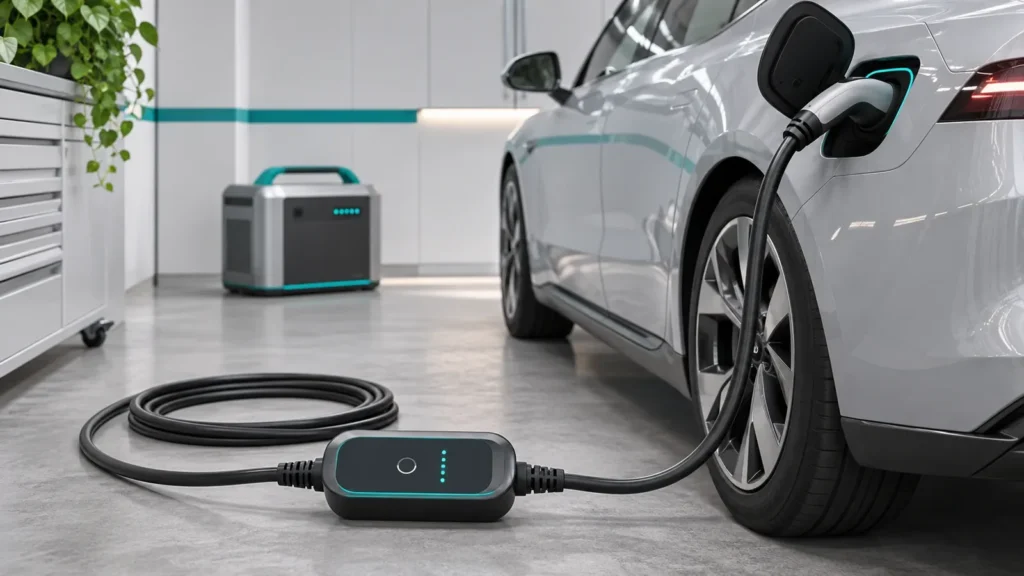
In short: “portable EV charger” covers two very different things. Most are portable EVSE: a cable with a control box that plugs into a socket and charges slowly from the building’s supply. The other kind carries its own battery, so it can charge a vehicle where there is no suitable supply at all. Portable EVSE suits occasional top-ups; battery-powered mobile chargers suit fleets, events, sites without power and roadside recovery.
Search for a portable EV charger and you will find three-pin cables for a few hundred pounds next to trailer-mounted battery units costing far more. They solve different problems. This guide explains the difference, what each can and cannot do, and how businesses choose.
What is a portable EVSE?
EVSE stands for electric vehicle supply equipment. A portable EVSE is a charging cable with a control and protection box built in. One end plugs into a socket, the other into the car. It does not store energy; it simply manages a safe charge from the supply it is plugged into.
- Three-pin cables: plug into a standard domestic socket. Indra, a home charger installer, says they only add around 6–8 miles of range per hour and are generally intended for very occasional use or emergencies.
- Industrial-socket units: plug into a commercial socket, such as a blue or red industrial socket, for higher power. They need a supply and circuit designed for that load.
Neither type removes the need for a properly designed electrical installation. The fifth edition of the IET Code of Practice for EV charging equipment installation is the reference electricians work to, and an electrician should check any socket you plan to rely on.
What is a battery-powered mobile charger?
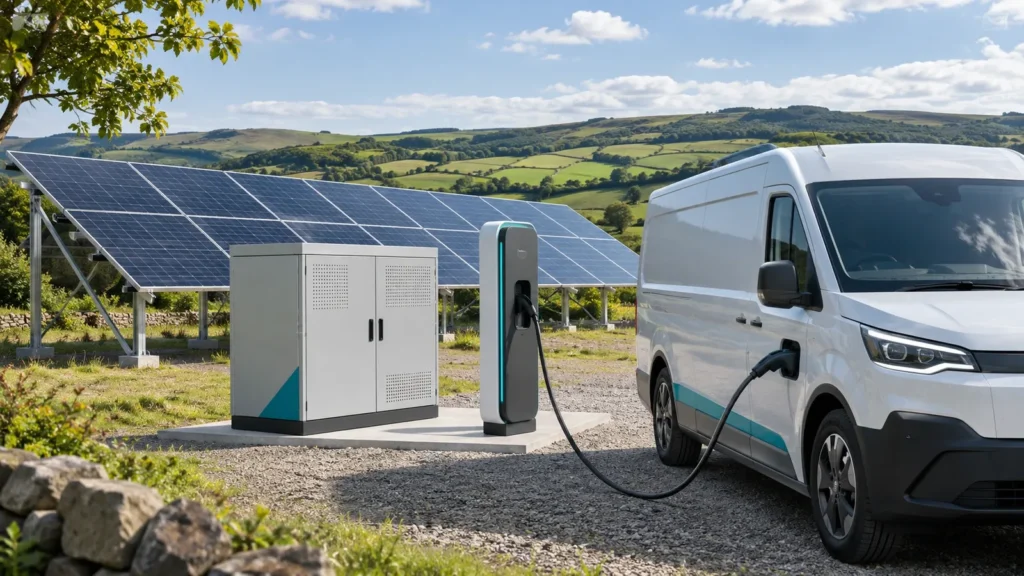
A battery-powered unit stores energy and delivers it to the vehicle, usually as DC through a CCS2 connector, or as AC through a Type 2 socket. It is recharged in advance from a grid supply, often overnight or off-peak, then moved to where it is needed. Units range from small wheeled packs to vans and trailers. In effect it is a portable EV charging station that does not depend on the site’s supply.
These units are the core of mobile EV charging: bringing charge to the vehicle instead of the vehicle to a charger. The same technology sits behind mobile energy storage more generally.
How do the two compare?
| Portable EVSE | Battery-powered mobile charger | |
|---|---|---|
| Needs a supply on site? | Yes, at the point of charging | No, only to recharge the unit |
| Typical output | Low, limited by the socket | From a few kW AC up to DC fast charging, depending on the unit |
| Energy per session | Unlimited while plugged in, but slow | Limited by the battery’s usable capacity |
| Cost | Low | Much higher |
| Best for | Occasional top-ups, backup | Fleets, events, sites without power, recovery |
When does a business need a battery unit?
- Waiting for a grid connection: a depot has vehicles before it has power; see options while you wait for a grid connection.
- Temporary sites: construction, film sets and events where there is no suitable supply; see battery power for events.
- Roadside and recovery: enough charge to get a stranded vehicle to a charger.
- Dealerships and car parks: moving charge to cars instead of moving cars to chargers.
A related option is a fixed EV charger with battery storage, which stays in one place but uses its own battery to deliver more power than the site’s connection allows. This is known as battery-boosted EV charging.
What should you check before buying?
- Usable energy: how many kWh the unit actually delivers per charge, not just the nameplate capacity.
- Output and connectors: AC or DC, power level, and whether it suits your vehicles.
- Recharge time: how long the unit takes to refill, and from what supply.
- Weight and transport: whether your vehicles and drivers can move it legally.
- Software and data: session records, remote monitoring and alerts.
- Service and warranty: who repairs it and how fast.
Our guide to mobile EV charger hire or buy covers these checks in detail, and starting a mobile EV charging business covers the commercial side.
Frequently asked questions
Is a portable EV charger the same as a mobile EV charger?
Not usually. “Portable charger” often means a cable that plugs into a socket, while “mobile charger” usually means a unit with its own battery that can charge without a local supply.
Can I use a three-pin portable charger every day?
It is generally intended for occasional or emergency use. If you rely on it regularly, have an electrician check the socket and consider a dedicated charger.
Can a battery-powered charger do DC fast charging?
Some can. Output depends on the unit, so check its continuous DC power and usable energy before buying or hiring.
Our solution recommendations service compares portable and mobile charging options for your vehicles and sites. Tell us what you need to charge.