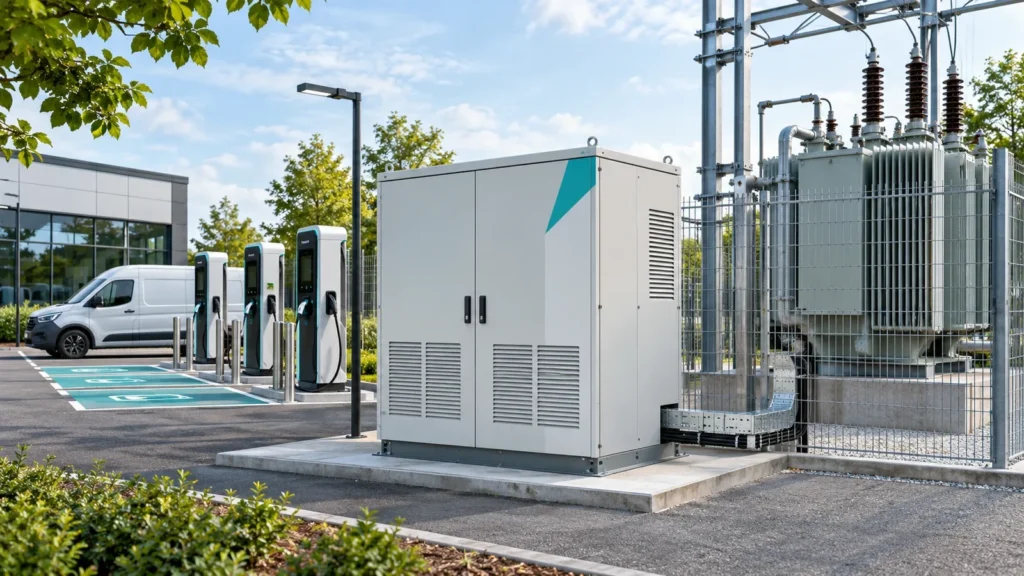
In short: in the battery storage vs grid upgrade decision, storage wins when the upgrade is slow or expensive, your charging peaks are short, and the battery can also cut peak electricity costs. A grid upgrade wins when you need lots of energy every day, the connection cost is modest, and it can be delivered in time. Compare the two over at least ten years, including running costs and timing, not just the upfront price.
When a site cannot supply enough power for its chargers, the question is usually framed as “battery or upgrade?” In practice the answer is often a combination: a smaller upgrade plus some storage, or storage now and an upgrade later. This article sets out how to compare them fairly.
What are you actually comparing?
In any battery storage vs grid upgrade comparison, remember that the two options solve different problems. A grid upgrade gives you more power, all the time. A battery gives you a store of energy that can be released at high power for a limited period, then refilled slowly from the existing connection.
So the first test is your load profile. If vehicles need high power for a few hours a day and the site is quiet the rest of the time, a battery can fill the gap. If the site needs high power for most of the day, the battery will empty and stay empty, and only more grid capacity will do.
What does a grid upgrade really cost?
Connection charges in Great Britain changed in April 2023. Under Ofgem’s access reforms, demand customers no longer pay a proportion of reinforcement costs upstream of their connection, unless the project crosses a high-cost threshold. That made many demand upgrades cheaper than they used to be, so an old quote may overstate today’s cost.
The full cost of an upgrade still includes:
- the connection works themselves, including any new substation or cable to your boundary;
- your own side of the meter: switchgear, cabling, groundworks and possibly a transformer;
- the cost of delay, if the upgrade arrives months or years after your vehicles; and
- any higher standing or capacity charges for the larger supply.
Timing is often the deciding factor. The size of the request matters too: in Devon, a charging hub that reapplied for a better-sized connection saved over £1 million and was energised three years sooner, Vattenfall reported.
What does battery-buffered charging really cost?
Battery prices have fallen sharply. BloombergNEF’s 2025 survey found pack prices for stationary storage fell to $70 per kWh. A finished system costs considerably more than the packs, once power conversion, enclosure, controls, installation and commissioning are added, so always compare full installed quotes.
On top of the purchase price, include:
- energy lost in charging and discharging the battery;
- maintenance and monitoring for the life of the system;
- gradual loss of capacity over time, and whether you will need to add more; and
- planning and fire safety requirements for larger systems.
Our article on battery storage warranties explains how to make sure the capacity you pay for is still there in year ten.
What can the battery earn or save?
A battery can do more than fill a power gap. Network charges are highest at peak times; as Drax explains, the red band usually runs from 4pm to 7pm. A battery charged overnight can supply chargers or the building during that window, reducing those charges. Where the setup allows, it may also take part in flexibility services. Count these savings only once you have confirmed them for your site and tariff.
A worked comparison
The figures below are illustrative assumptions, not quotes, to show the method. Replace every number with your own.
| Item | Grid upgrade | Battery on existing supply |
|---|---|---|
| Upfront cost (illustrative) | £250,000 | £200,000 |
| Available from | Month 30 | Month 6 |
| Extra running costs per year | Higher capacity charges | Maintenance, losses |
| Peak cost savings per year | None | Depends on tariff and use |
| Cost of delay | Vehicles idle or on hired charging for 24 months | None after month 6 |
| Supports future growth | Yes, up to the new limit | Limited by energy stored per day |
In this example the battery looks better while the upgrade is two years away, but the upgrade looks better once the fleet’s daily energy outgrows what the battery can refill. That is why many sites end up with both: a battery now, and a right-sized upgrade later, with the battery then used to cut peak costs. You can size the battery side with our battery buffer calculator.
When does each one win?
| Battery storage tends to win when | A grid upgrade tends to win when |
|---|---|
| The upgrade is years away | The upgrade can be delivered in time |
| Charging peaks are short and predictable | High power is needed most of the day |
| Peak electricity charges are high | The connection cost is modest |
| The site may move or change | The site is long term and growing |
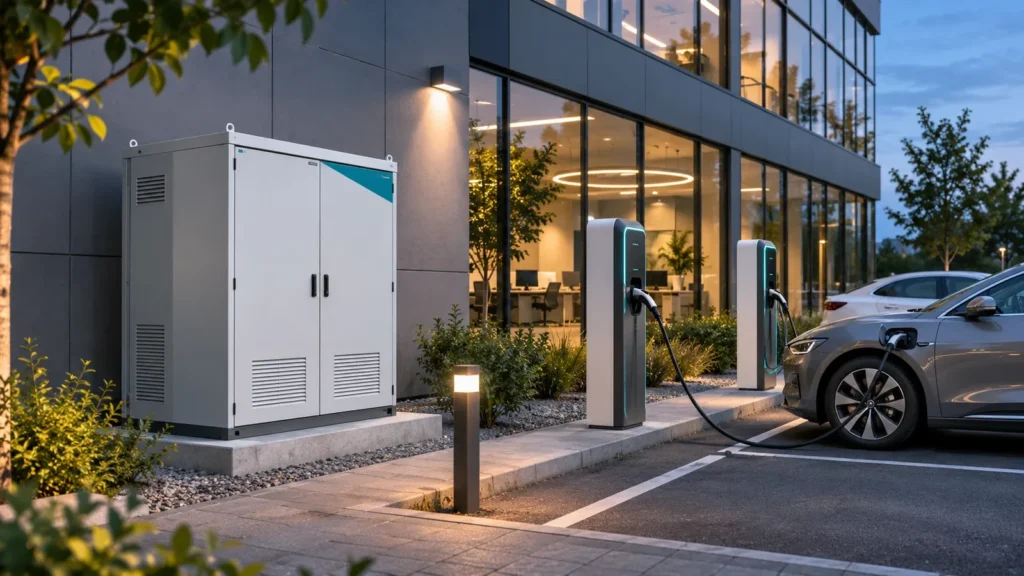
An EV charger with battery built in is one way to add storage without a separate system. For the technical side of pairing chargers with storage, see when battery-integrated fast charging makes sense, and for the steps before any purchase, the five questions to ask first.
Frequently asked questions
Is battery storage cheaper than a grid upgrade?
Sometimes. It depends on the upgrade cost and timing, your load profile and the savings the battery can make. Compare both over the same period, with the same assumptions.
Can I start with a battery and upgrade later?
Yes, and it is often the best route. Apply for the upgrade early, use storage to bridge the gap, and keep the battery afterwards to reduce peak costs.
How long does battery storage last?
It depends on chemistry, temperature and how hard it is cycled. Ask for a warranty in years and cycles, with a guaranteed capacity at the end.
Our solution recommendations service runs this comparison with your own data. Send us your load profile and connection quote and we will tell you which route makes sense.