In short: on-street EV charging serves residents who cannot charge at home because they have no driveway. In England, councils can fund it through the government’s Local EV Infrastructure (LEVI) Fund. The key decisions are where to put chargers, which type to use, how to procure and contract them, and how to keep them working and fairly priced. Plan from residents’ needs, build in accessibility and reliability, and choose a contract model that matches the council’s appetite for risk.
As more households switch to electric cars, councils face a clear gap: residents without off-street parking. This article sets out how councils can plan and procure on-street EV charging that residents will actually use.
How much public charging is there today?
As of 1 July 2026, government statistics recorded 121,171 public EV chargers in the United Kingdom, of which 28,887 were rated rapid or above. Residents without driveways need chargers near their homes, not just on main routes, so councils need a local view of where they live.
What funding is available?
The Local EV Infrastructure Fund supports local authorities in England to plan and deliver charging infrastructure for residents without off-street parking, with a focus on local, primarily low-power on-street charging. The government’s allocation methodology says a further £343 million capital and £37.8 million resource funding will be available over two financial years, allocated to Tier 1 local authorities.
Which types of on-street charger?
| Type | Best for | Watch out for |
|---|---|---|
| Lamp-post chargers | Streets where lamp posts sit at the kerb edge | Lower power, and lamp-post position and condition |
| Bollard or post chargers | Streets where kerbside posts can be installed | Footway width and street clutter |
| Charging hubs | Car parks or side streets near dense housing | Walking distance from homes |
| Rapid chargers | Taxis, car clubs and quick top-ups | Higher cost and grid capacity |
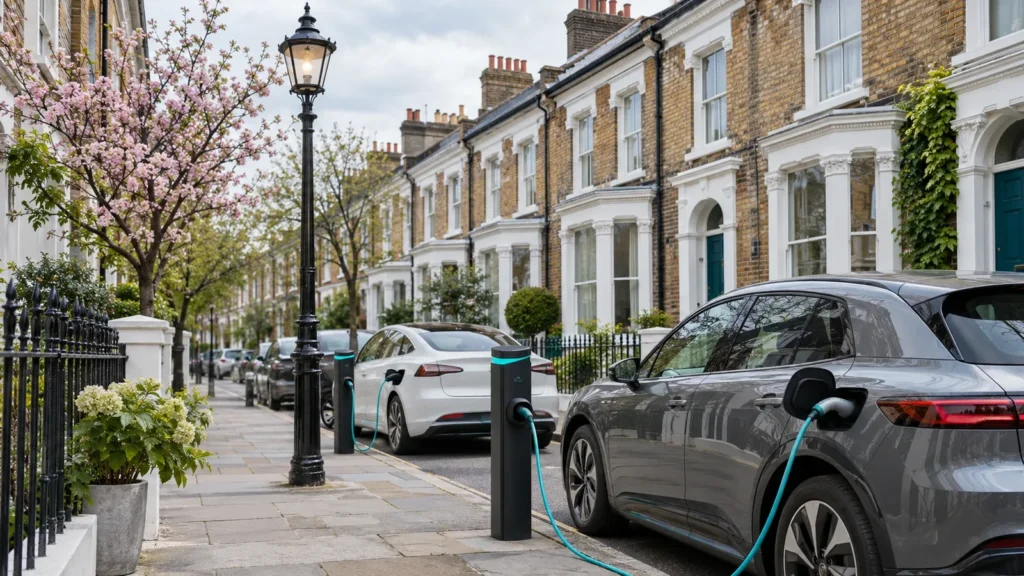
For residents who park overnight, low-power charging on their street usually fits best. A mix of on-street chargers and a few hubs often gives the widest coverage.
Where should chargers go?
- Demand: areas with high proportions of homes without off-street parking.
- Requests: residents’ requests, gathered through a simple online form.
- Practicality: footway width, existing street furniture and grid capacity.
- Accessibility: PAS 1899:2022 sets out how to make public charge points accessible; build it in from the start.
Which rules apply?
On-street chargers are public charge points, so the Public Charge Point Regulations 2023 apply. They cover payment, clear pricing in pence per kWh, open data and a free 24-hour helpline, with a 99% reliability requirement for rapid networks. Make sure contracts place these duties clearly on the operator.
How should councils procure?
Councils usually choose between owning the chargers, a concession where an operator invests and runs them, or a mix. The right model depends on how much risk and income the council wants to take on.
| Contract point | Why it matters |
|---|---|
| Reliability and repair targets | Residents depend on these chargers every night |
| Pricing rules | Fair, transparent prices, and how they can change |
| Data access | Usage data to plan the next phase |
| Term and exit | What happens to the assets at the end of the contract |
| Open standards | OCPP chargers, so operation can change hands |
Our guides to writing a charger tender and charger uptime and service levels cover how to specify these.
Frequently asked questions
Should councils own on-street chargers?
Some do, some prefer concessions. Ownership gives more control and income; concessions transfer cost and risk to an operator.
Are lamp-post chargers powerful enough?
For cars parked overnight, low-power charging is often enough. Check the power with suppliers against residents’ typical needs.
How should councils decide locations?
Combine data on homes without off-street parking with residents’ requests and practical checks on footways and grid capacity.
Our procurement and supplier selection service helps councils specify, procure and contract on-street charging. Tell us about your programme.