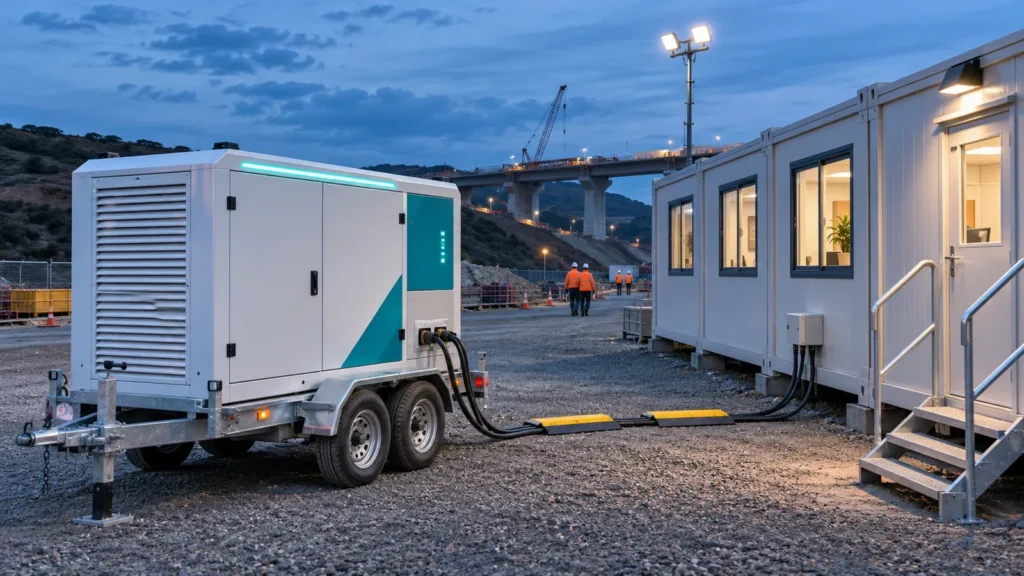
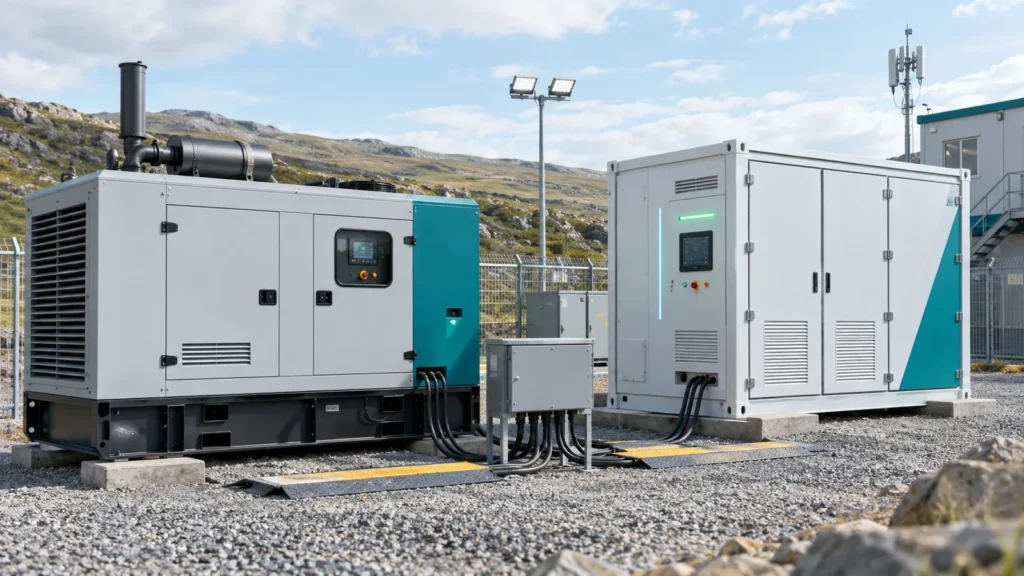
In short: battery power units win on noise, local emissions and running cost wherever loads are light or variable, such as welfare cabins, lighting, tools and overnight loads. Diesel generators still suit long, heavy, continuous demand where no grid power is available. On many sites the best answer is a hybrid: a battery that handles most hours, with a smaller generator that runs efficiently when it is needed.
Temporary power used to mean a diesel generator, sized for the biggest load the site might ever see and left running around the clock. Two things have changed. Diesel has become more expensive and more regulated, and battery power units have become a practical alternative. Here is a fair comparison for site managers and hire companies.
What changed for diesel?
From 1 April 2022, most sectors, including construction, lost the right to use rebated red diesel. Bevan Brittan’s summary sets out the change, which also removed the entitlement to rebated biofuels for those sectors. Sites now pay the full rate of duty on fuel for generators and plant. Pinsent Masons notes that fines and criminal sanctions can apply to anyone intentionally or recklessly breaching the rules.
In London, emissions rules for non-road mobile machinery are tightening too. The Greater London Authority’s NRMM guidance covers engines rated from 37 kW to 560 kW. Current standards are EU Stage IV as a minimum, rising to Stage V across London from 1 January 2030, with only zero-emission machinery allowed from 1 January 2040. Generators already need to meet Stage V.
The low-load problem
Most site generators are sized for the peak: the moment the tower crane, the welders and the heaters all run at once. For most of the day, and all of the night, the load is a fraction of that. A diesel engine running lightly loaded burns more fuel for each kWh it produces, and over time can suffer “wet stacking”, where unburnt fuel builds up in the exhaust.
A battery does not have this problem. It delivers small loads as efficiently as large ones, makes no noise and produces no exhaust on site. That is why the overnight hours, when a generator might run just to power a security light and a welfare cabin, are where batteries save the most.
Head to head
| Factor | Battery power unit | Diesel generator |
|---|---|---|
| Running cost at low load | Low; efficient at any load | High; fuel use per kWh rises at light load |
| Noise | Near silent | Engine noise; limits night working near homes |
| Local emissions | None on site | Exhaust emissions; subject to NRMM rules in London |
| Long, heavy continuous loads | Limited by stored energy | Strong, as long as fuel is delivered |
| Refuelling or recharging | Needs a grid supply or charger to refill | Needs fuel deliveries and secure storage |
| Hire or purchase cost | Usually higher up front | Usually lower up front |
Where each one wins
- Battery: welfare cabins, site offices, lighting, small tools, security and monitoring, and anywhere noise or air quality matters.
- Diesel: heavy, continuous loads with no grid supply nearby, such as large cranes or long-running pumps, where the generator runs close to its rated load.
- Hybrid: mixed sites. The battery covers light and overnight loads, and the generator starts only to recharge the battery or meet a peak, running at an efficient load when it does.
The savings from a well-sized hybrid can be substantial. A Purdue University study modelling battery-diesel systems found that a right-sized battery-diesel generator system allows for more than 50% cost savings relative to a standalone generator. That is a modelled result; real savings depend on your load profile.
How to size it
Before choosing, log the real load for at least a week. Many hire companies can fit a power logger to an existing generator. Look at the peak, the average and the overnight minimum. If the average is a small fraction of the generator’s rating, a battery or hybrid is likely to save money and noise.
For carbon reporting, use the UK government’s greenhouse gas conversion factors to turn litres of diesel saved into emissions avoided.
Hire or purchase checklist
- Usable energy (kWh) and continuous output (kW) of the battery unit
- How it is recharged, and how long that takes
- Whether it can run alongside a generator as a hybrid, and how it controls the generator
- Remote monitoring of charge level and load
- Footprint, weight and delivery access
- Swap-out time and support if it fails
Frequently asked questions
Can a battery power unit run a whole construction site?
Small sites with modest loads, yes, if it can be recharged. Larger sites usually need a hybrid or a grid connection for heavy plant.
Do battery power units fall under London’s NRMM rules?
The NRMM rules apply to engines. A battery unit has no engine, which is part of its appeal on London sites. Check the GLA guidance for how hybrids are treated.
Is HVO a good alternative to diesel?
HVO can cut lifecycle carbon compared with diesel, but it still burns in an engine on site, with the same noise and low-load issues. Since April 2022 it is no longer available at a rebated rate for most sectors.
Choosing the right power mix for a site is part of our solution recommendations service. Send us your site’s load profile and we will help you compare the options.